
Little Hands, Big Skills: 5 Easy Montessori Snack-Making Trays for Kids
Transforming snack time into a child-led activity is one of the simplest, most rewarding ways to nurture independence, fine motor control, and confidence at home. Using the classic Montessori tray system, you provide your child with everything they need—pre-portioned, organized, and sized just right for small hands—empowering them to complete their snack entirely on their own.
"Never help a child with a task at which he feels he can succeed." — Maria Montessori
Why the Montessori Tray System Works
Instead of handing your child a finished plate, a prepared tray invites active participation, curiosity, and practical life learning:
Defined Workspace: A small tray or cutting board clearly marks their prep area and keeps inevitable spills contained.
Child-Sized Tools: Mini spreaders, child-safe butter knives, and blunt skewers build dexterity safely and effectively.
Built-In Autonomy: Pre-portioned ramekins give little ones total control over their choices and portions without overwhelming them.
Focus on Process: Snack prep becomes an engaging sensory rhythm where building confidence matters far more than visual perfection.
5 Appealing Snack Trays Little Learners Love
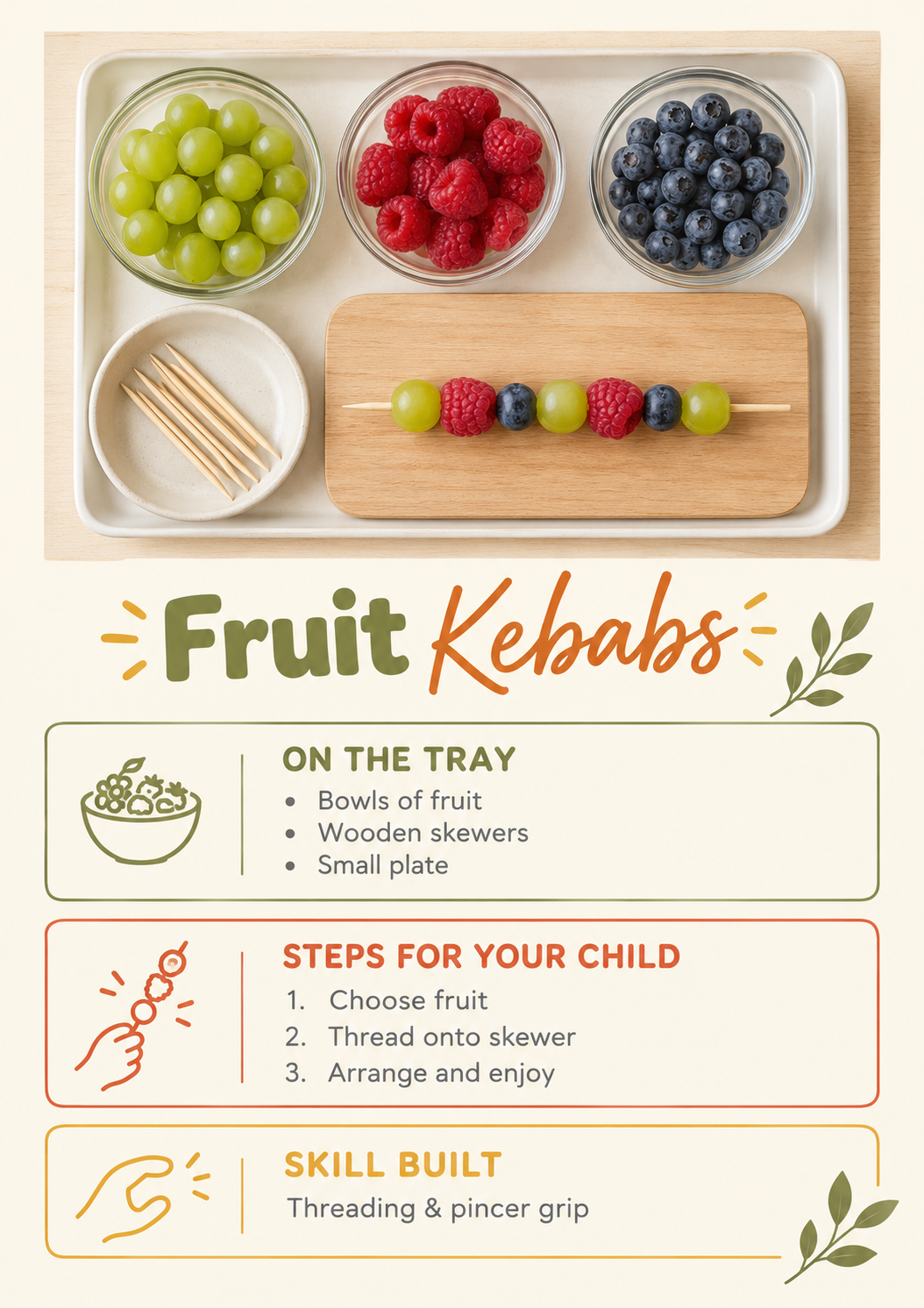
1. Rainbow Fruit Kebabs
The Experience: A bright, sensory-rich tray featuring colorful berries and grapes that turns snack prep into an exciting threading challenge.
Why It’s Great: Threading soft fruit onto skewers refines the pincer grasp and builds bilateral hand coordination while letting your child explore vibrant colors and textures.
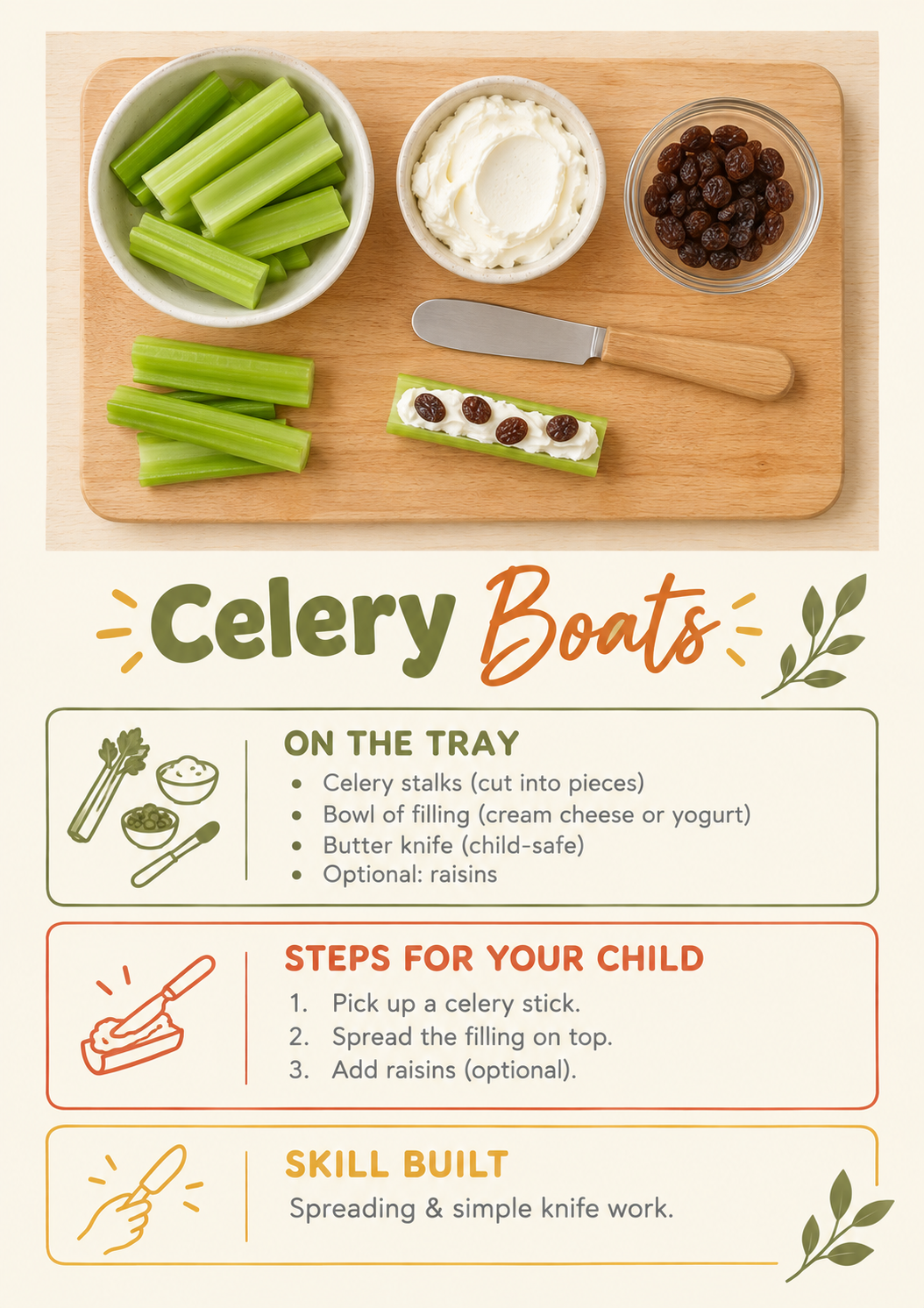
2. Crunchy Celery Boats
The Experience: Crisp, fresh celery stalks paired with rich cream cheese or yogurt and topped with sweet raisins for a playful "ants on a log" experience.
Why It’s Great: The deep groove of the celery provides natural boundaries for little hands practicing smooth knife spreading and precise finger placement.
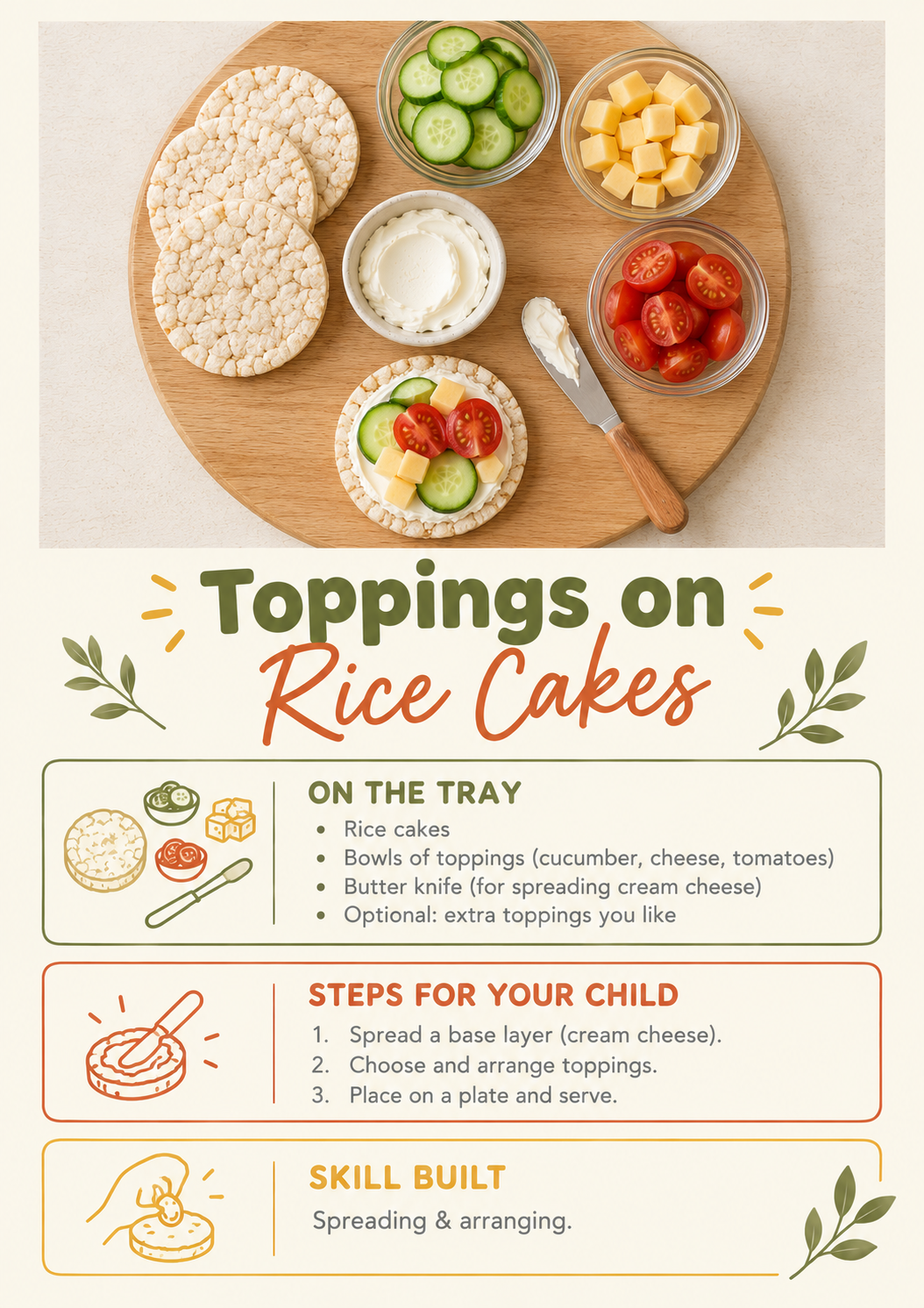
3. Savory Rice Cake Canvas
The Experience: Light, crunchy rice cakes served as an edible open canvas, accompanied by creamy spreads and vibrant slices of cucumbers, cheese cubes, and juicy cherry tomatoes.
Why It’s Great: This tray encourages spatial awareness and artistic creativity as children spread their base and arrange colorful shapes into one-of-a-kind designs.
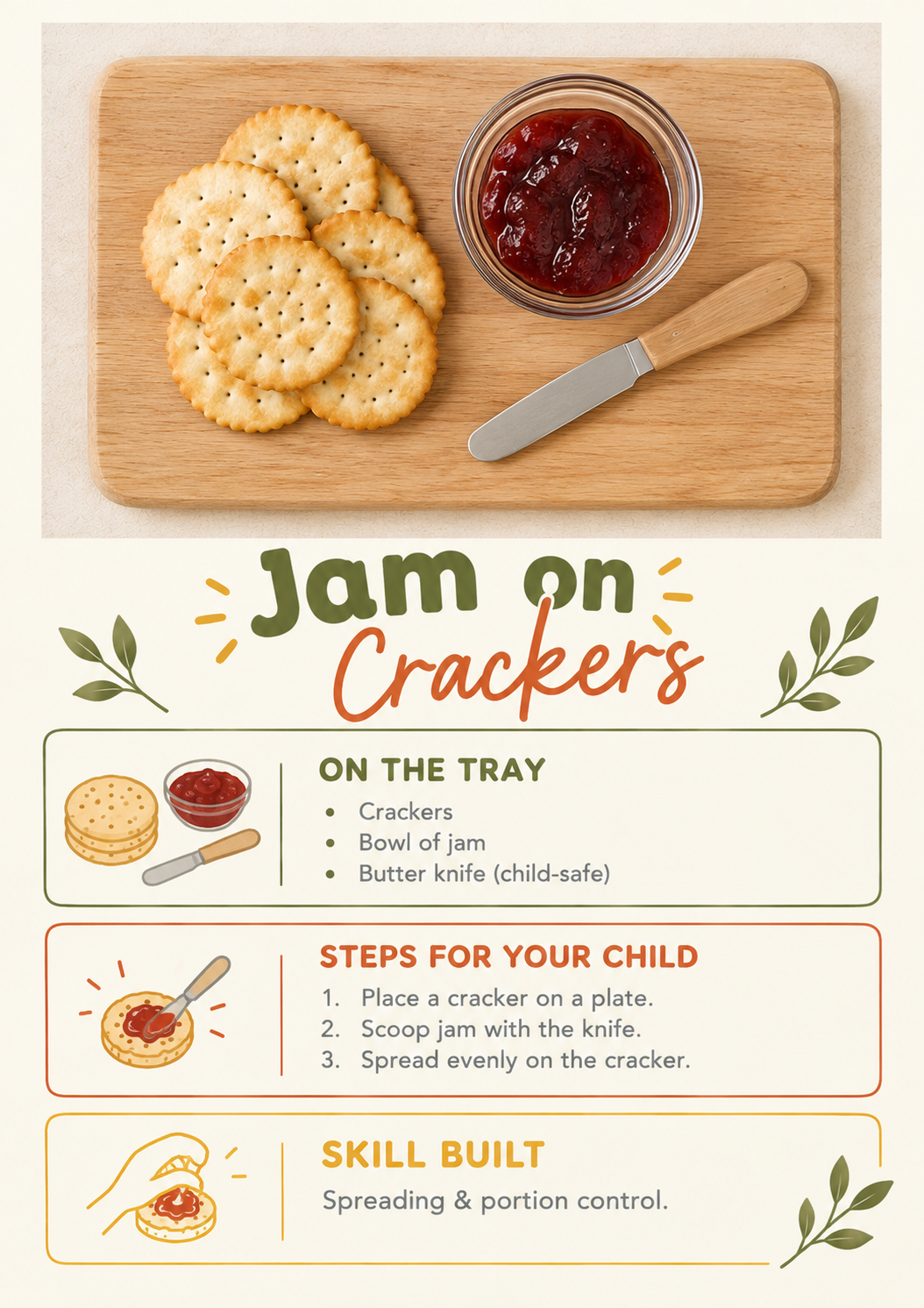
4. Sweet Jam & Crisp Crackers
The Experience: Golden, flaky crackers presented with a ramekin of glossy fruit spread and a toddler-friendly spreader.
Why It’s Great: Spreading across delicate crackers teaches children pressure regulation—learning just how much force to apply without crumbling the cracker beneath.
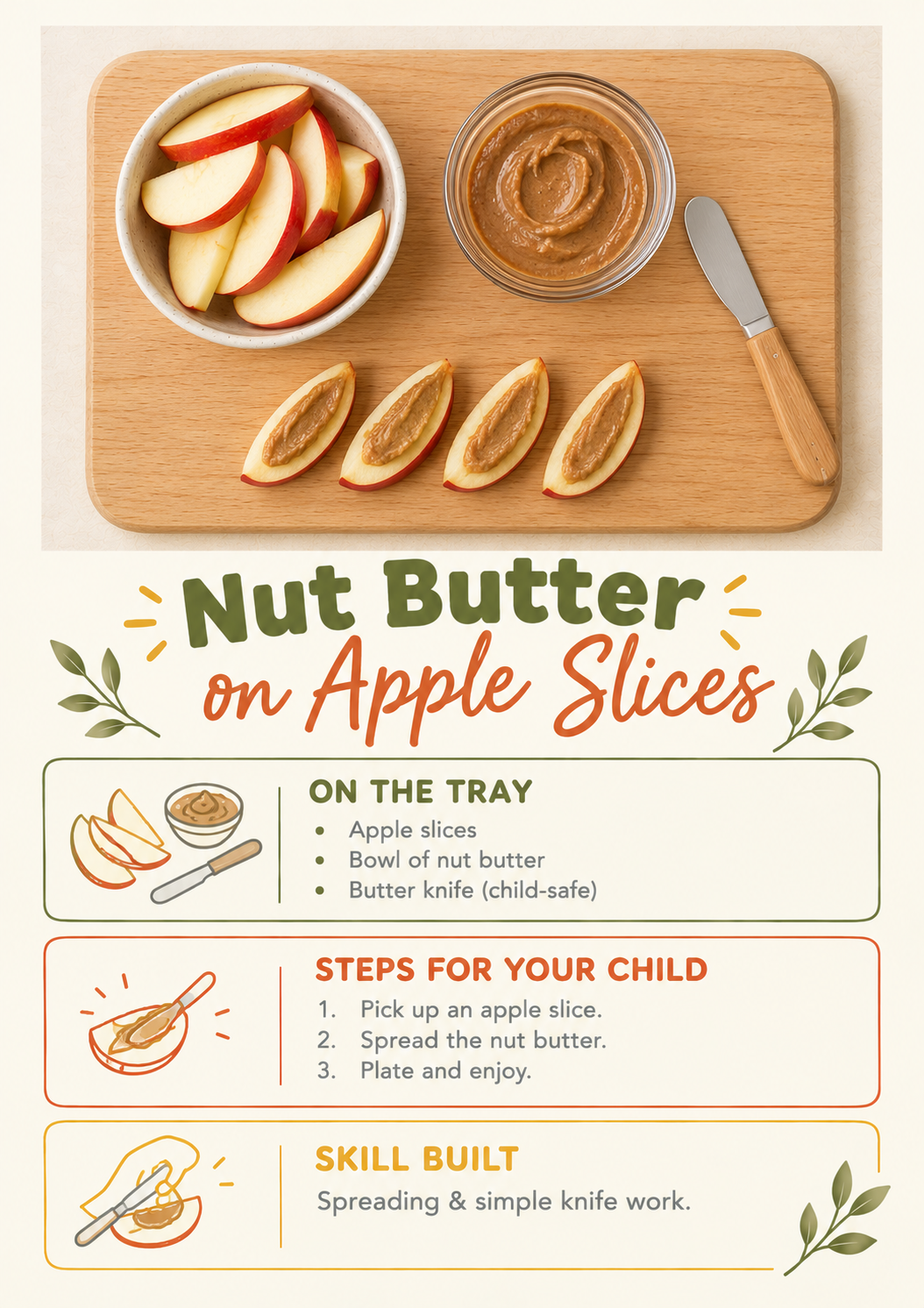
5. Nut Butter & Crisp Apple Smiles
The Experience: Crisp, sweet apple wedges ready to be layered with creamy seed or nut butter for a satisfying, nutrient-dense treat.
Why It’s Great: Navigating the curved slope of an apple slice offers a fun, rewarding challenge that develops hand stabilization and two-handed coordination.
Get the Complete Parent Guide (Free!)
Ready to bring calm, independent snack routines into your daily rhythm?
We have put together a printable, full-color guide containing step-by-step visual breakdowns, equipment setup checklists, and practical tips to ensure your child succeeds from day one.
Fill out your email to get the copy of your guide for free.
Why We Chose Real Photos Over Cartoon Animals for Our Toddler Busy Book
If you've flipped through our Montessori-Inspired Busy Book, you've probably noticed something right away: there are no cartoon lions, no smiling pink elephants, no googly-eyed cows. Every animal, every fruit, every everyday object is a real photograph.
That wasn't a design accident. It was a deliberate choice — and it's rooted in something Maria Montessori understood almost a century before "screen time" was even a phrase: young children build their understanding of the world from concrete reality, not abstract fantasy.
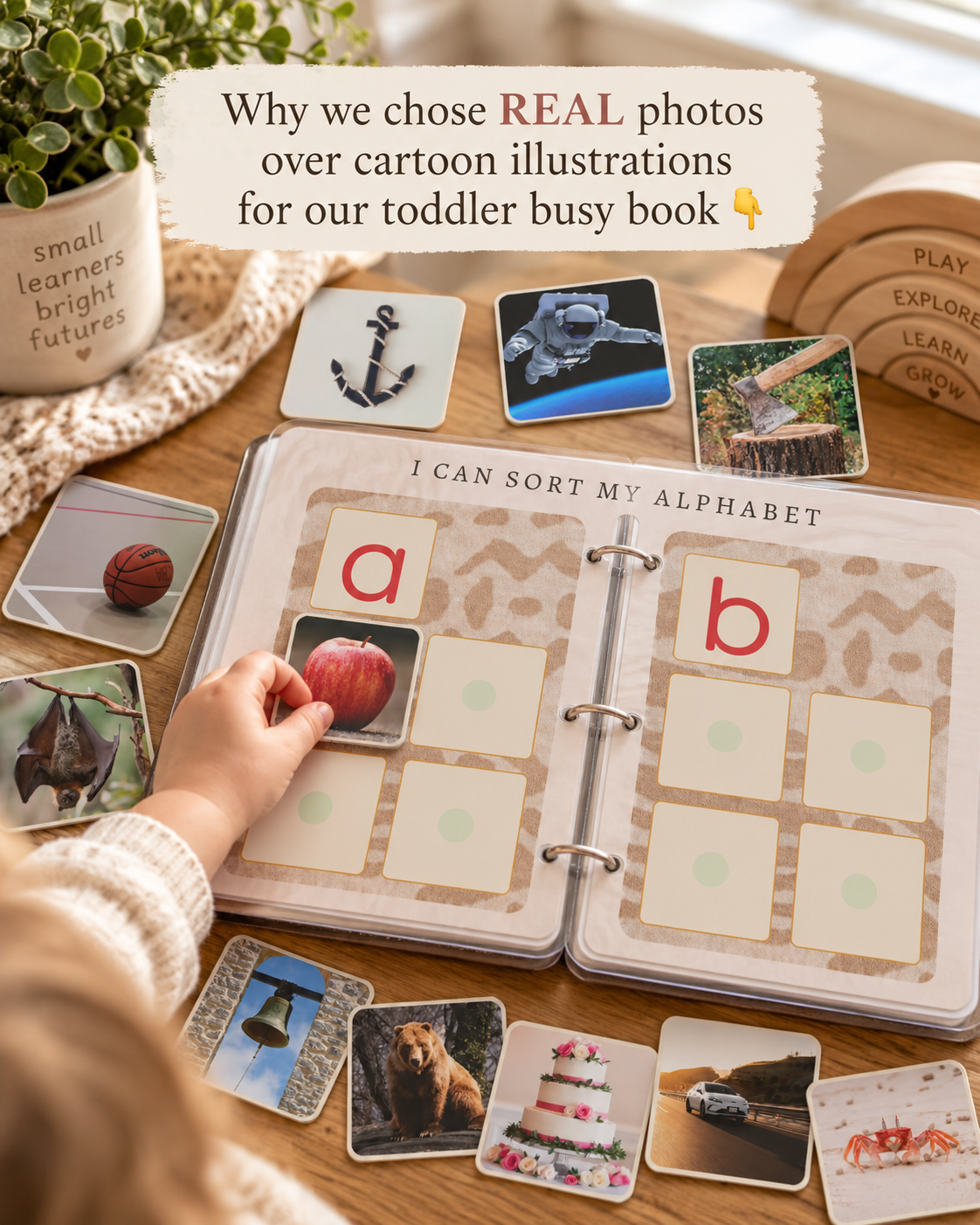
Here's why that matters, and what it actually looks like inside the book.
Cartoon animals are everywhere in children's media — bright, exaggerated, and undeniably charming. But a bubblegum-pink elephant with cartoon eyelashes doesn't exist anywhere in your toddler's actual world.
Before the age of three, children are still forming their foundational map of reality: what things actually look like, sound like, and behave like. Montessori believed this stage of development should be grounded in truth first. Fantasy, abstraction, and imaginative play all have their place — but later, once a child has a firm grip on what's real.
That's why when your child turns to the animal pages in our busy book, they see an actual elephant. Not a cartoon stand-in for one.
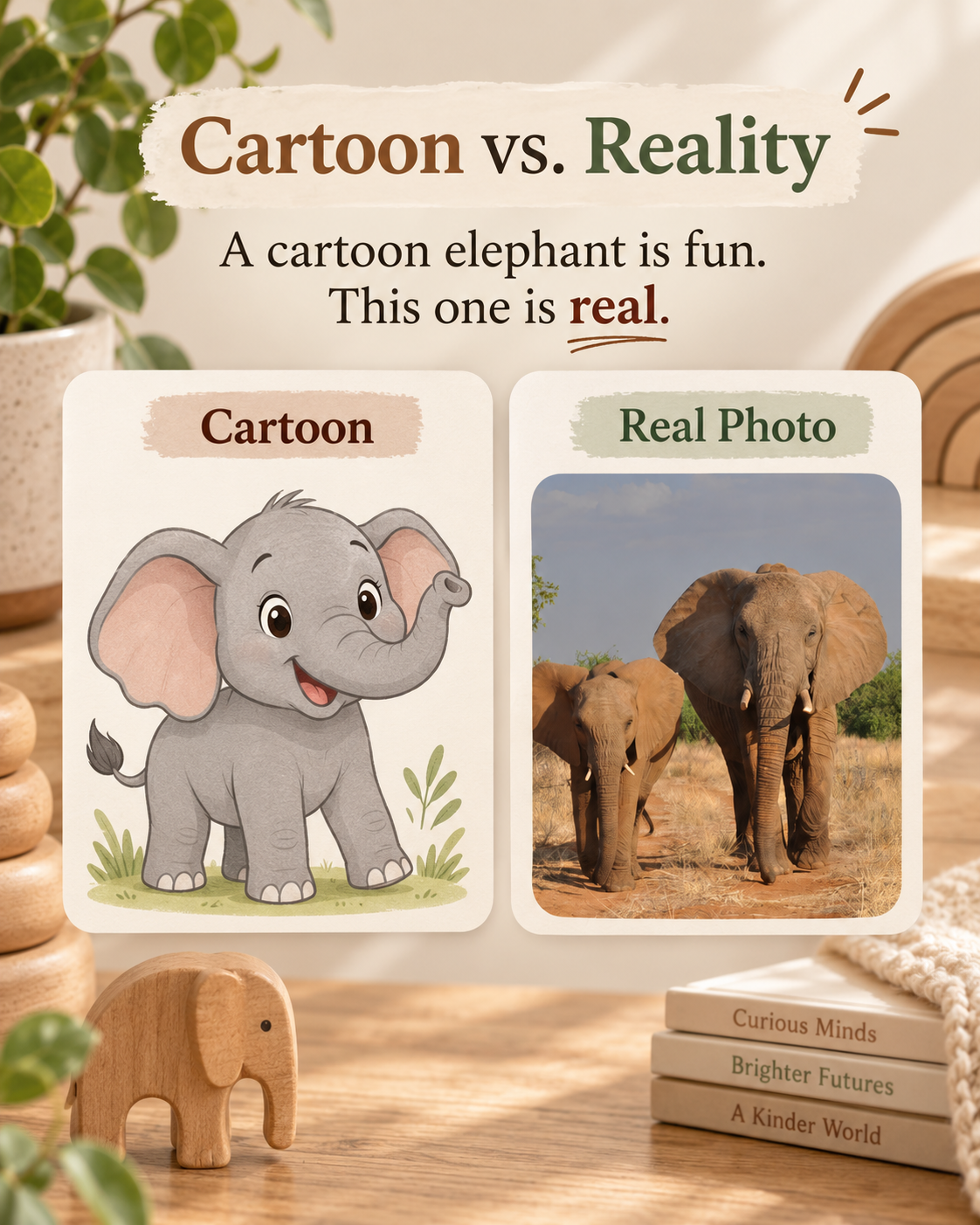
Book photo → real animal → instant recognition
Here's the cognitive payoff: when a toddler sees a real photo of a lion in their busy book, and later sees a real lion — at the zoo, in a documentary, in another book — their brain doesn't have to do any translation work. There's no gap between "the cartoon version" and "the real thing." The image in the book is the thing.
That direct match matters. Every time a child's book-image lines up with real-world reality, it reinforces an accurate mental model instead of building one they'll eventually have to unlearn or revise. A pink elephant doesn't teach a toddler anything true about elephants — a real one does.
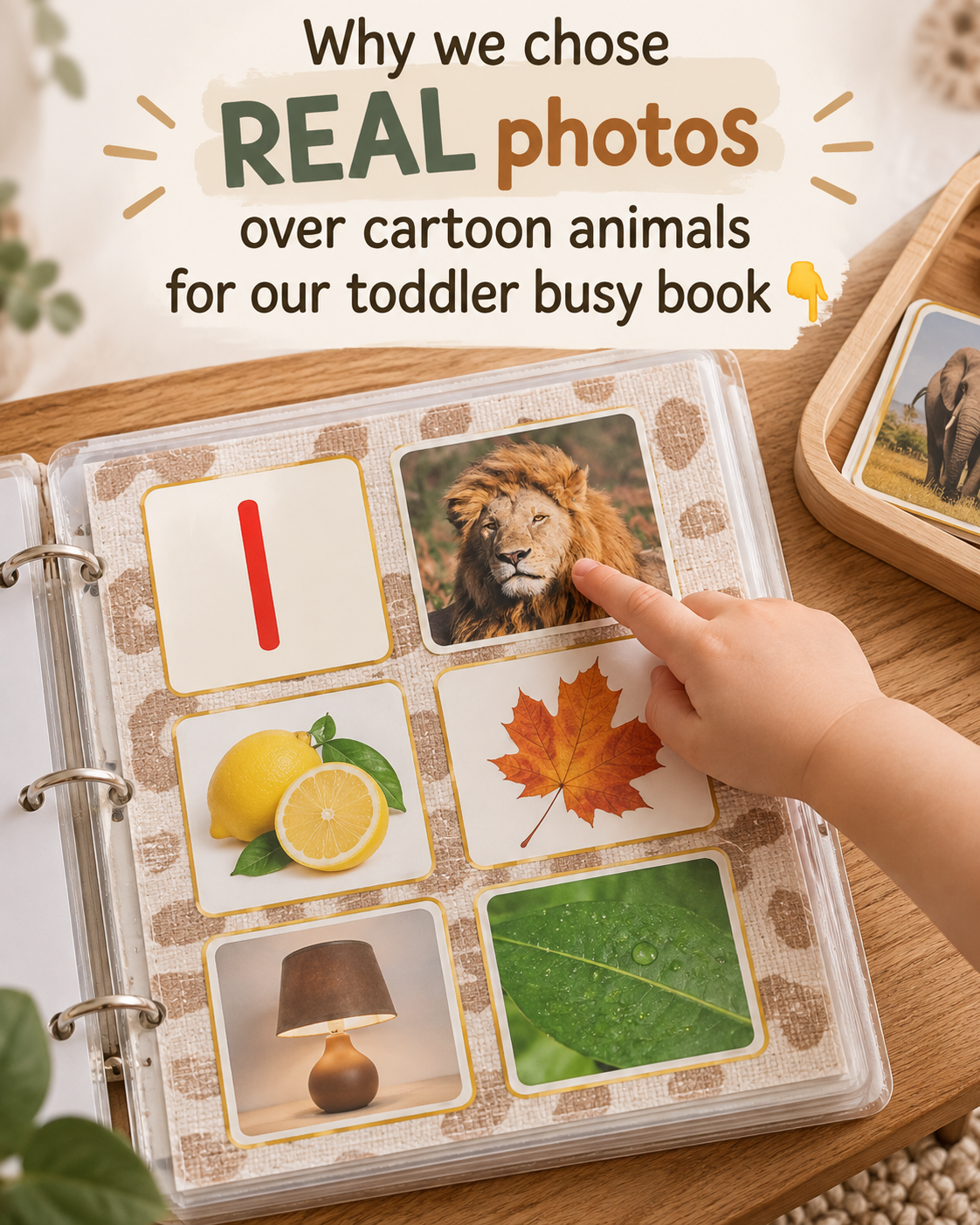
150 pages of real-world discovery
Our busy book isn't just animals. It's 150 pages of hands-on, Montessori-inspired activities — and the same "real over cartoon" philosophy runs through every page.
Realistic fruits and vegetables — blueberries, watermelon, avocado, pumpkin — photographed exactly as they appear at the market or on your kitchen counter.
Everyday objects your toddler already encounters — an egg, a lemon, a mirror, a balloon — so the connection between "page" and "life" is immediate and effortless.
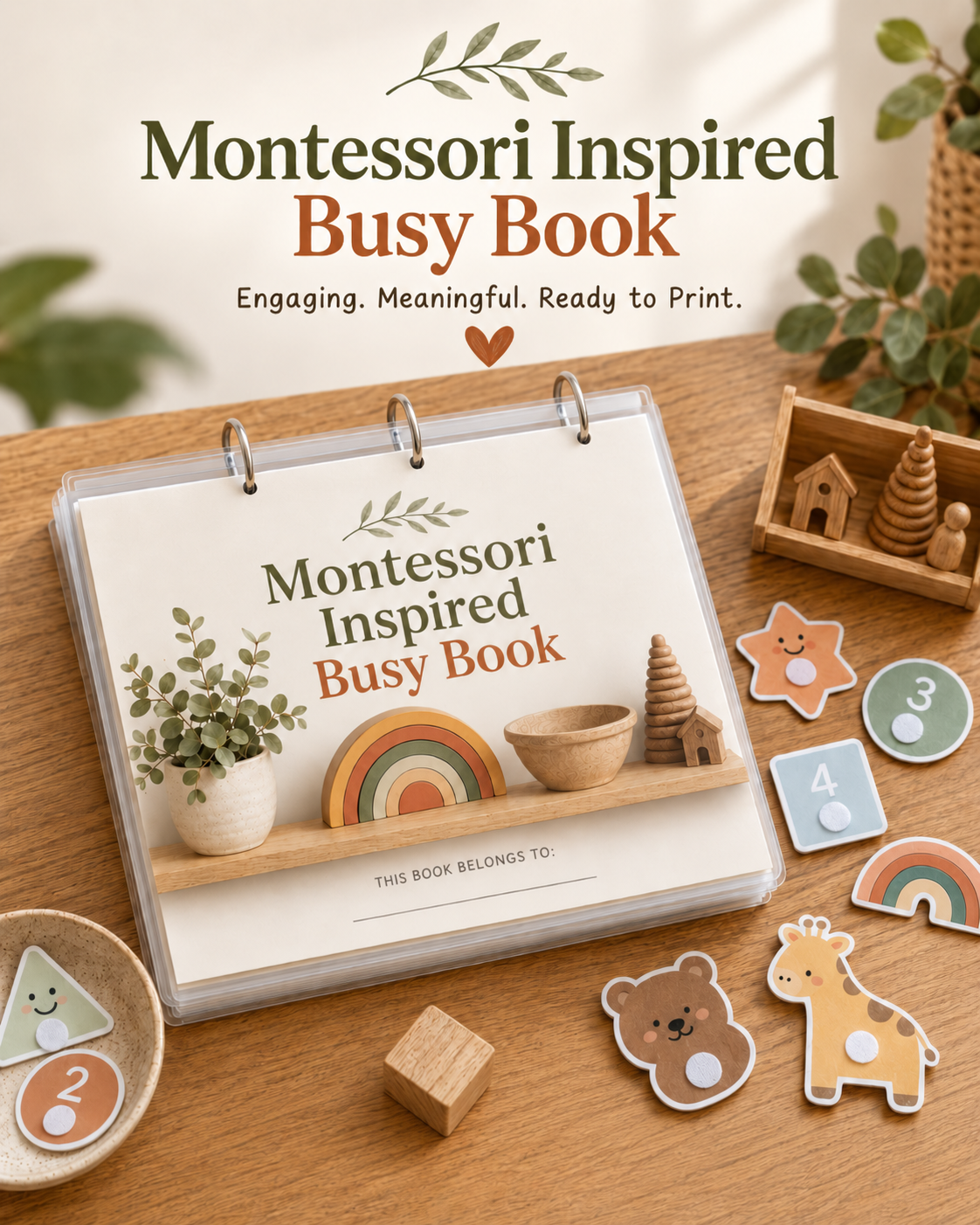
Give your little one realistic discovery tools
Toddlers are building their entire understanding of reality one image at a time. We think that foundation deserves to be built on things that are actually true.
Ready to give your little one a head start on real-world discovery? Link the link to check out 👇
The $14 Magic Wand That Just Replaced Screen Time (9 Wildly Fun Sensory Hacks)
Picture this: your toddler is completely locked in. Hands steady, eyes wide, totally silent—for 30 uninterrupted minutes. No iPad, no bargaining, no sudden meltdown. Just one dirt-cheap little tool doing all the heavy lifting.
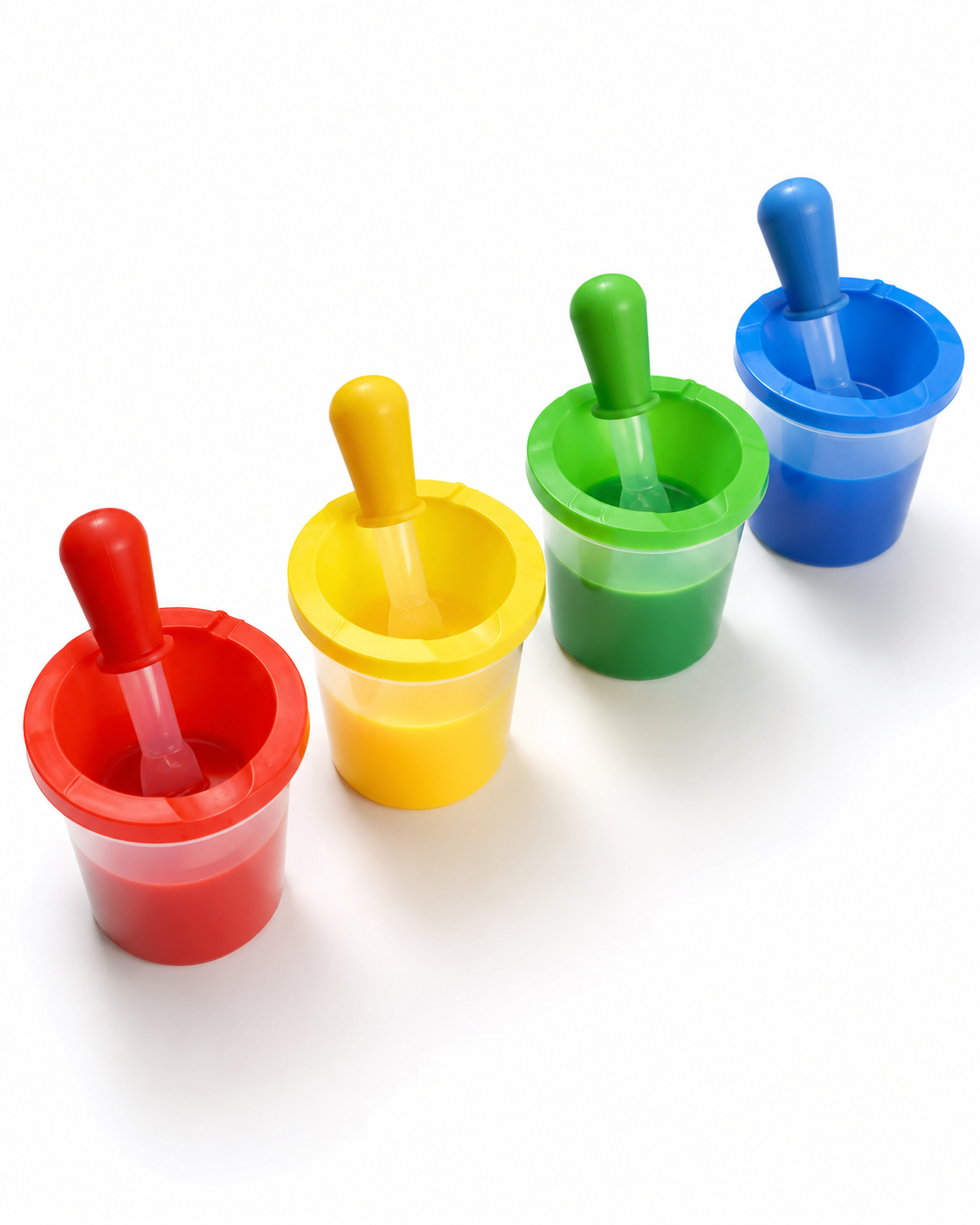
The secret? A basic pack of liquid medicine droppers/pipettes.
It turns out this humble squeeze-and-release gadget is an absolute powerhouse for building pencil-grip strength, hand-eye coordination, and razor-sharp focus—all disguised as pure, messy fun.
Below are 9 irresistible ways to put it to work.
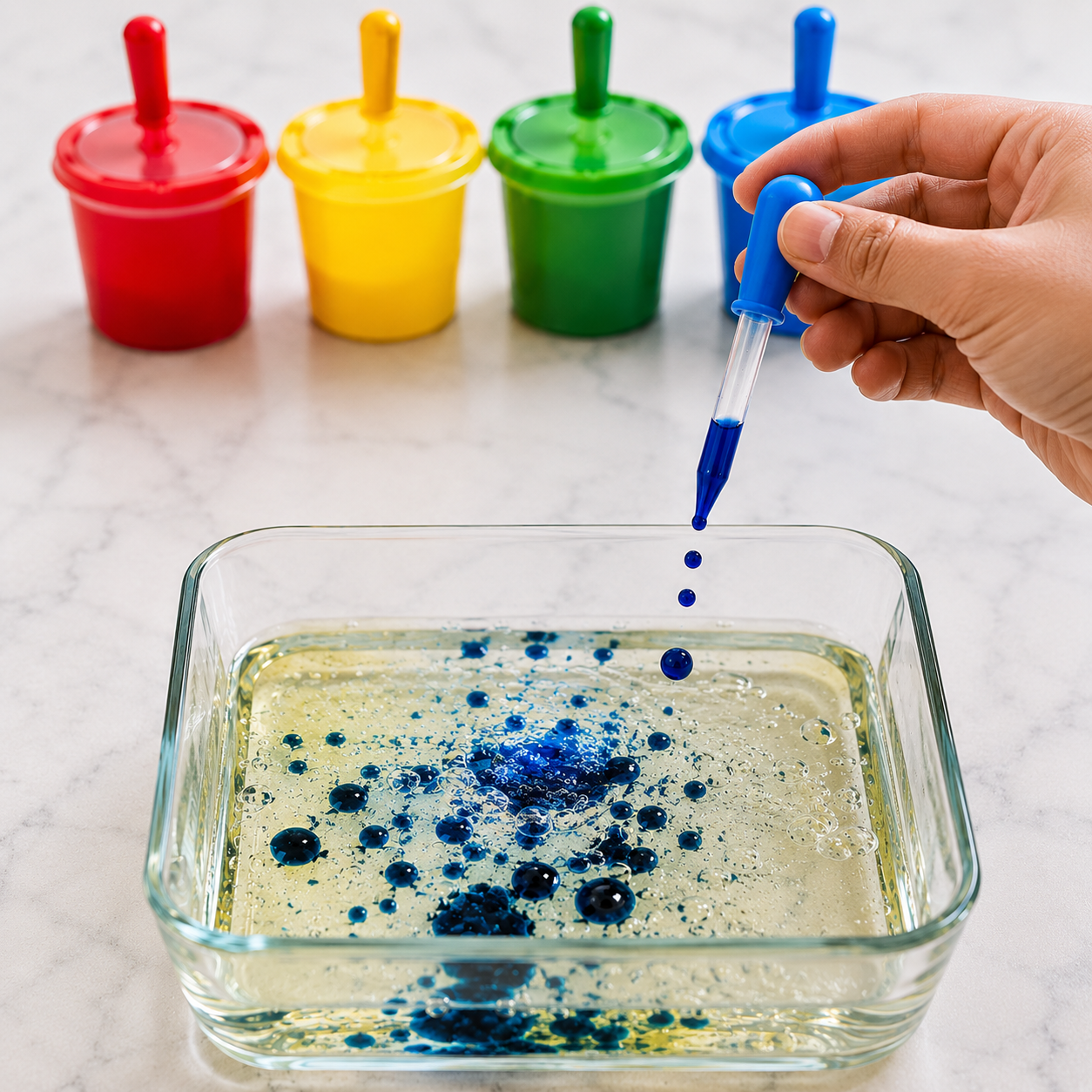
1. 🌈 Liquid Fireworks
Fill a clear dish with water and a thin slick of baby oil. Hand your toddler the pipette loaded with food dye and watch their jaw drop as the color bursts through the oil layer, blooming into slow-motion underwater clouds.
The Magic: Strengthens the exact pincer grip needed for handwriting, with an accidental masterclass in liquid density.
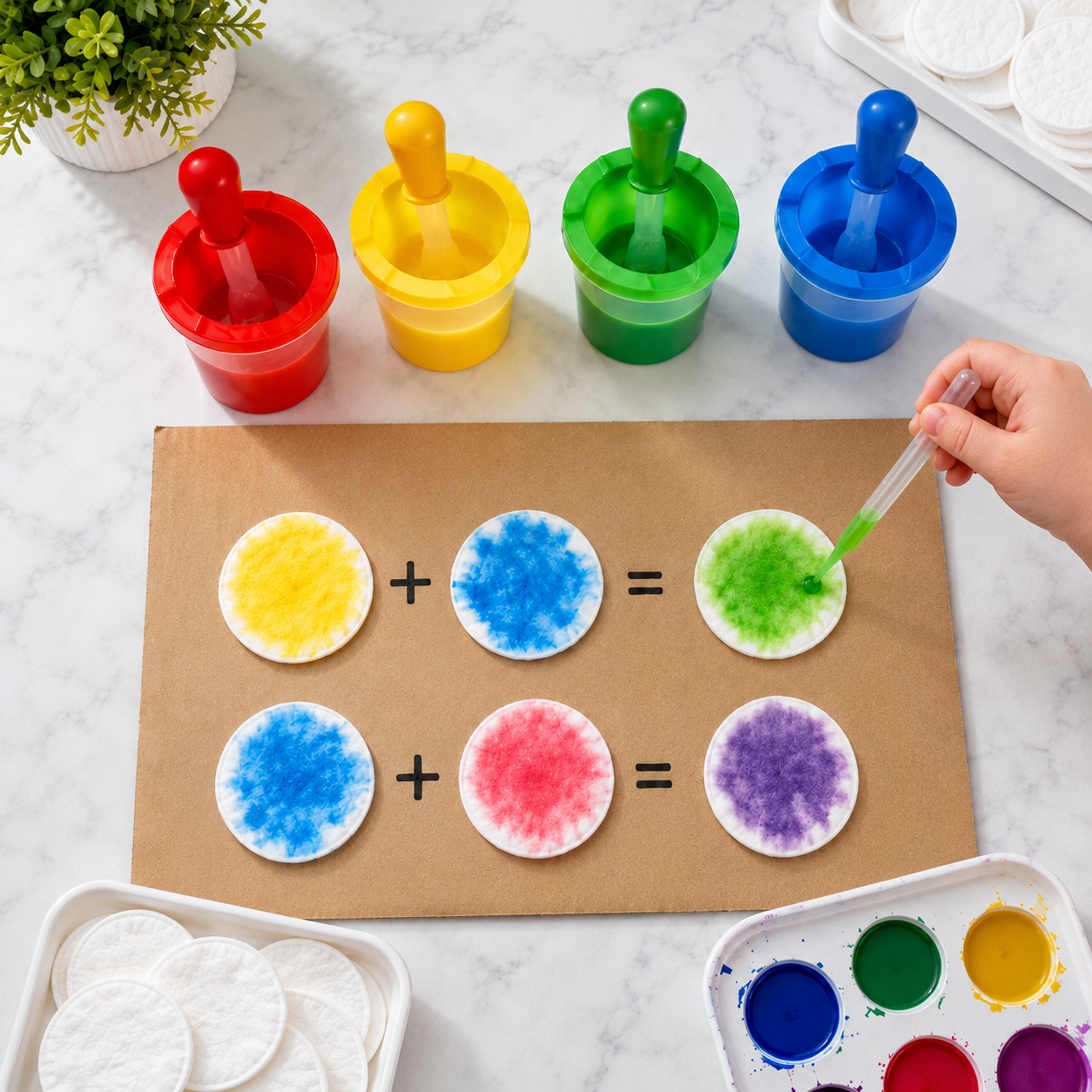
2. 🎨 The Color Equation Lab
Line up cotton rounds on cardboard with drawn-on “+” and “=” signs. Have them drop yellow on pad one, blue on pad two, and mix them on pad three. Watching a vibrant green appear out of nowhere hits like real-world sorcery every single time.
The Magic: Transforms basic color theory into a thrilling, tactile discovery.
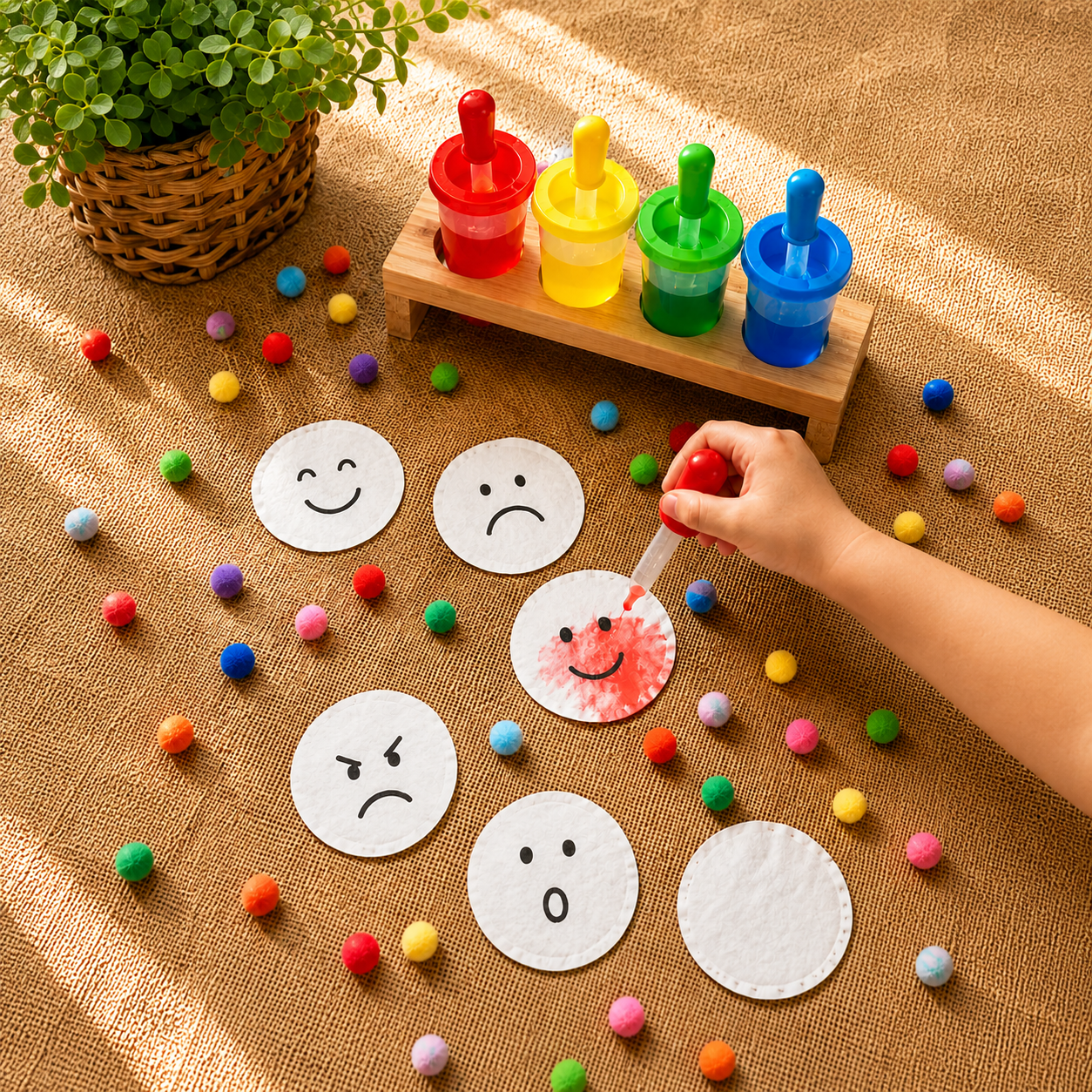
3. 😊 The "Mood Glow" Decoder
Draw cartoon emotion faces (wildly happy, grumpy, startled) onto felt rounds. Ask your child how they’re feeling today and let them "light up" that face with drops of liquid watercolor.
The Magic: Blends fine-motor precision with gentle emotional literacy—a rare activity that flexes both hands and heart.
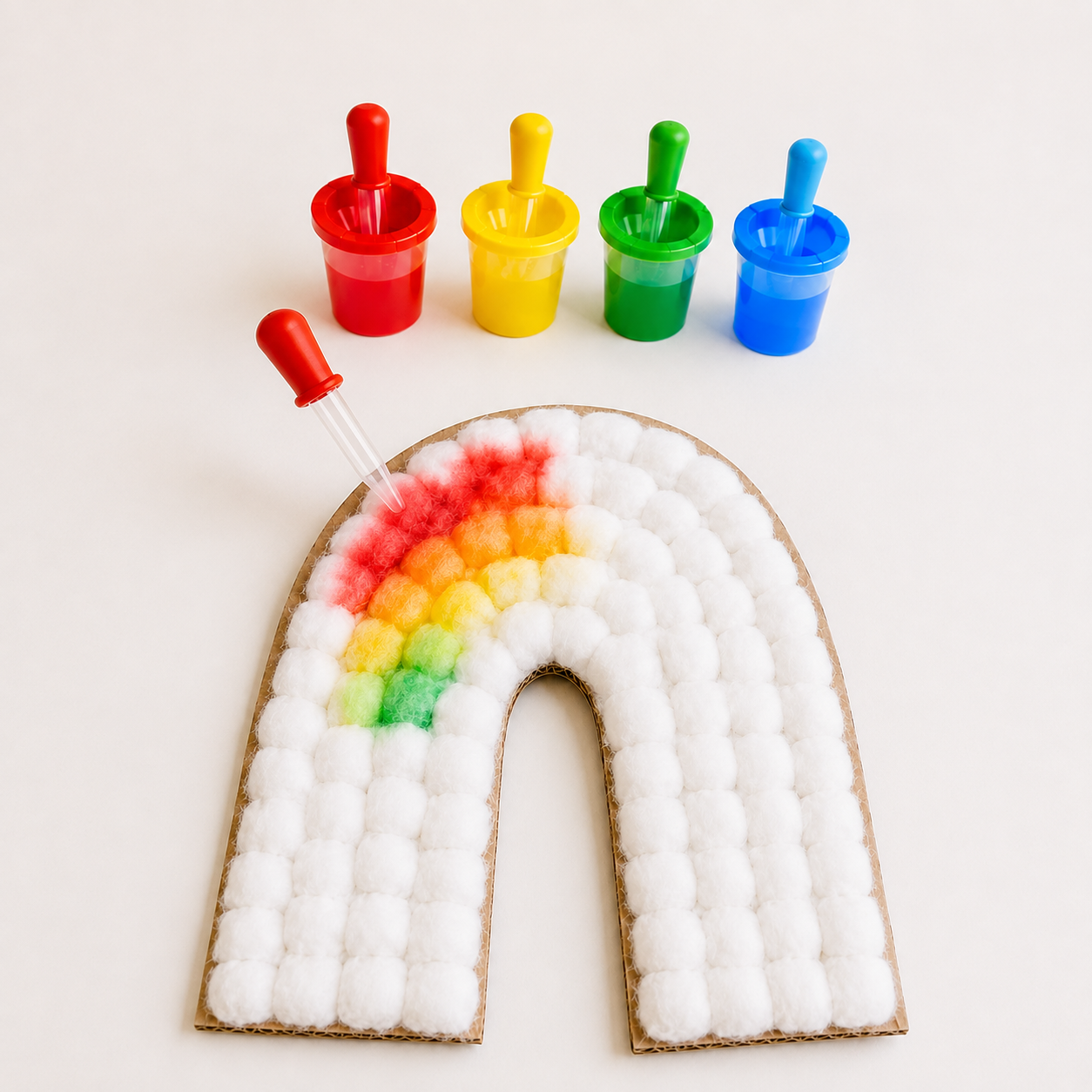
4. 🌤️ Fluffy Cloudburst Crafts
Glue a dense rainbow of cotton balls onto heavy cardstock. Let your kid saturating each row with targeted drops of color, watching the dye instantly wick across the fibers like lightning through clouds.
The Magic: A rich tactile experience that dries into a legit, fridge-worthy piece of 3D art.
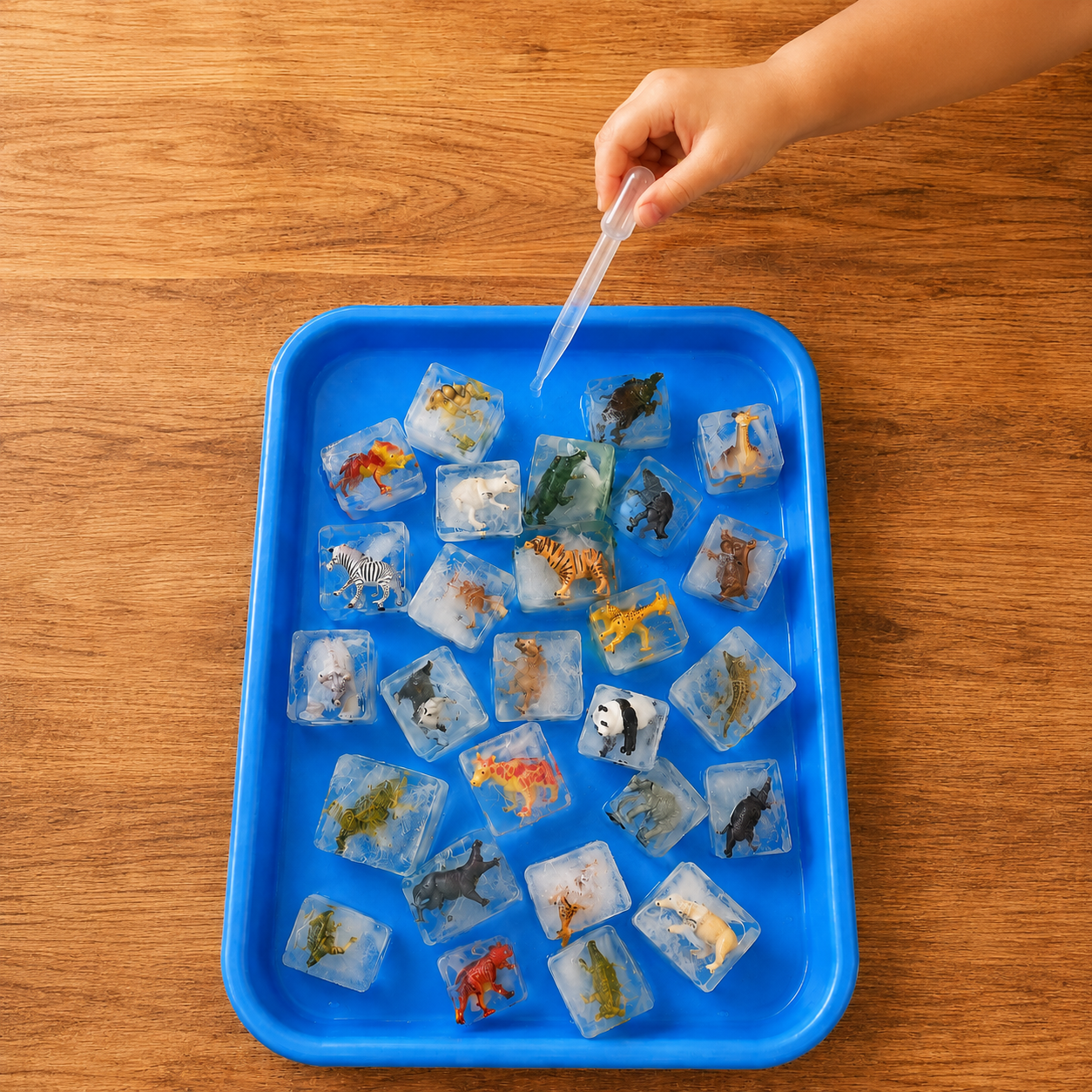
5. 🧊 The Great Arctic Rescue Mission
Trap small plastic dinos or sea creatures inside ice cubes overnight. Arm your kid with a pipette, a cup of warm salt water, and an urgent mission: melt the glaciers drop by drop to free the animals before naptime.
The Magic: High-stakes drama that teaches temperature, phase changes, and sustained patience with zero cleanup.
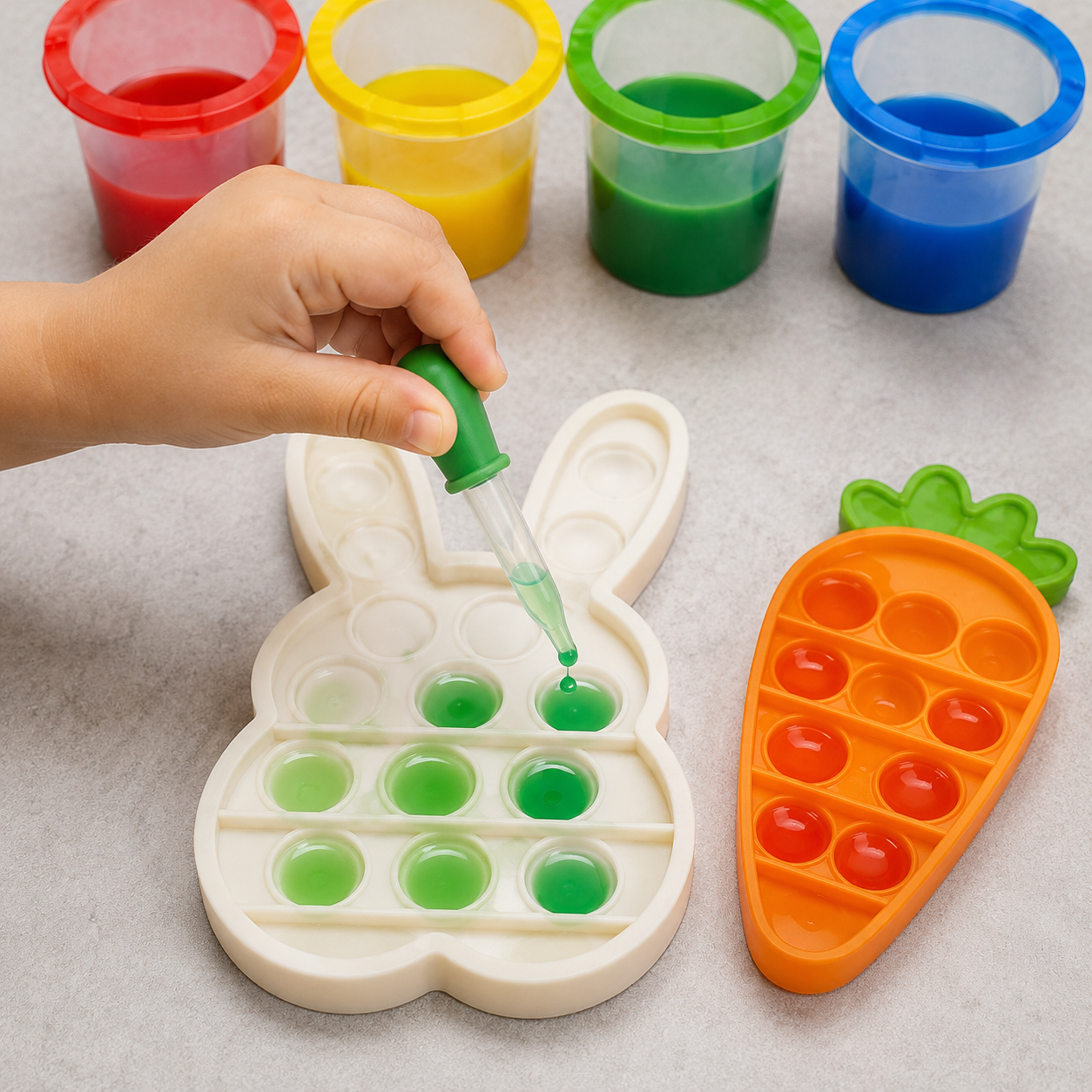
6. 🐰 Pop-It Pixel Art
Dust off that forgotten silicone Pop-It toy. Challenge your preschooler to fill every single dimple with precise, single drops of color to create ombre rainbow gradients across the rows.
The Magic: Insanely addictive precision training that keeps little fingers steady and brains locked in.
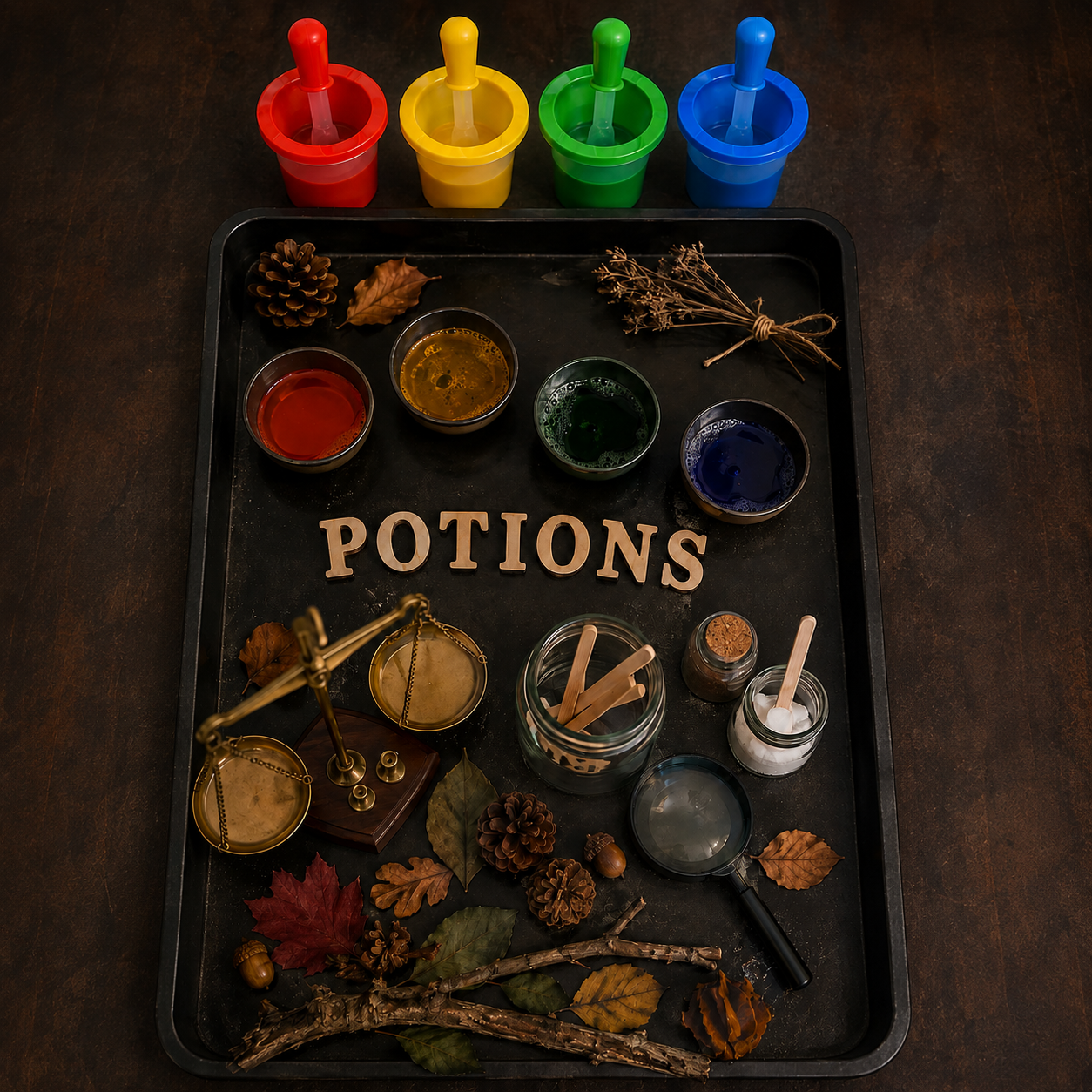
7. 🧪 The Mad Alchemist's Brew
Set out mini jars of colored water, dried leaves, glitter, and pinecones. Give them their "wand" (the dropper) and watch an elaborate fantasy world of dragon potions and fairy serums take over your kitchen table.
The Magic: Deep, open-ended imaginative play that easily buys you an entire uninterrupted afternoon.
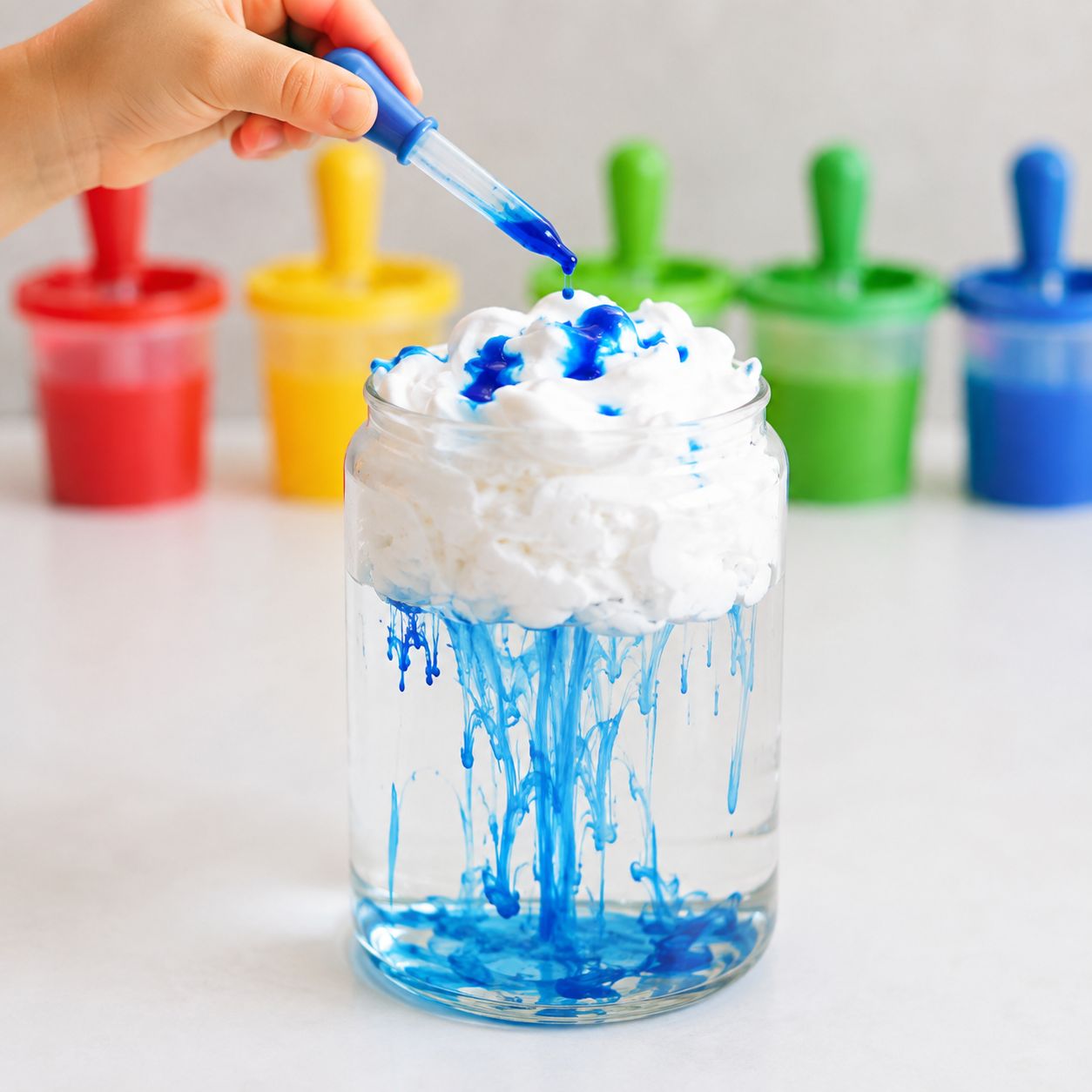
8. 🫧 Shaving Cream Thunderstorms
Top a mason jar of water with a thick, billowy layer of foam shaving cream. Drop liquid dye straight into the top and wait for the weight to punch through, creating silk ribbons of "rain" swirling through the water below.
The Magic: A stunning, drop-dead gorgeous visual model of actual atmospheric precipitation.
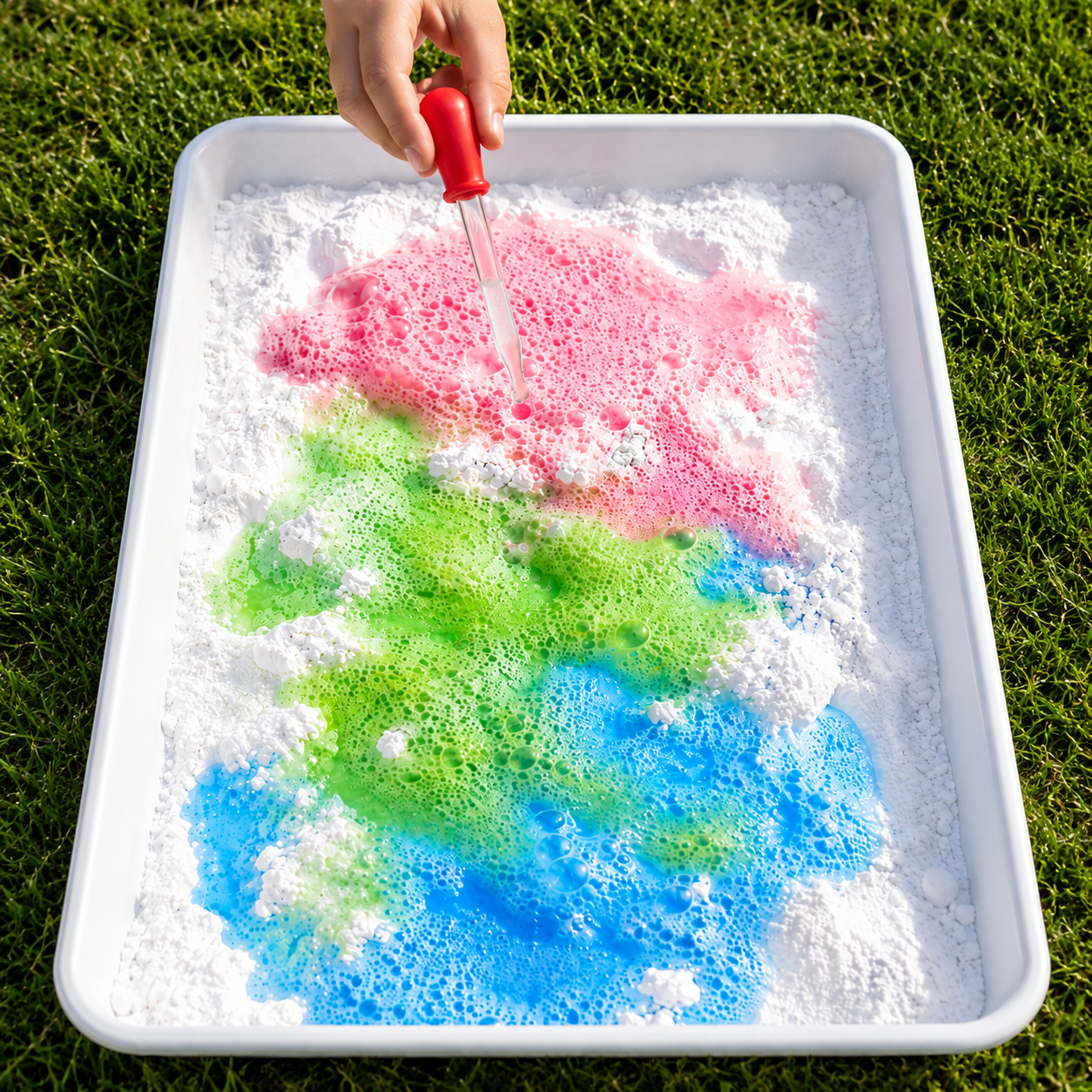
9. 🧪 The Rainbow Acid-Base Fizz-Fest
Layer a shallow dish with baking soda and let your tiny scientist drop vibrant hues of colored vinegar across the surface. Watch the instant eruption of bubbling, multi-colored foam as the shades crash into each other to form a giant, fizzy swirl masterpiece.
The Magic: Transforms simple kitchen chemistry into a mesmerizing explosion of color and sound that never gets old.
The Ultimate Parenting Cheat Code
You don't need a $100 curated sensory subscription box gathering dust in a closet. Grab a set of droppers, raid your pantry for baking soda and food dye, and let the quiet, focused magic happen.
👉 Grab the $14 Dropper & Pipette Set Here to get started today!
Save this list for your next rainy afternoon and tag a fellow parent who desperately needs 30 minutes of screen-free peace!
You Don't Need a Teaching Degree to Homeschool Pre-K (Here's What You Actually Need)
You Don't Need a Teaching Degree to Homeschool Pre-K (Here's What You Actually Need)
If you've been eyeing that "enroll now" button for a traditional preschool and feeling a knot in your stomach, you're not alone. Somewhere between the tuition costs, the drop-off tears, and the nagging feeling that maybe I could just do this myself, a lot of moms land in the same place: standing at the edge of homeschooling their 3-to-5-year-old, unsure where to even begin.
Here's the good news. Pre-K is not kindergarten moved a year early. It's not daycare with flashcards. And it definitely doesn't require a teaching degree, a Pinterest-perfect playroom, or a color-coded bell schedule taped to the fridge.
What it does require is a little structure, a handful of good materials, and the willingness to follow your child's curiosity. That's it. That's the whole secret.
The problem with most homeschool advice
Search "how to homeschool preschool" and you'll fall into a rabbit hole of 40-page curriculum guides, $200 boxed programs, and Instagram reels of impossibly tidy learning shelves. It's overwhelming — and honestly, most of it skips the one thing a first-time homeschooling mom actually needs: a simple, doable starting point.
That's the gap Little Learners at Home: A Pre-K Homeschooling Starter Course was built to fill.
What Pre-K learning actually looks like
Before you can plan a single lesson, it helps to understand what a 3-to-5-year-old's brain and body are actually ready for. A child sorting toy cars by color? That's a math lesson — even though it doesn't look like one. Five ten-minute activities spread across the day? That teaches more than a single hour-long sit-down session ever will.
The course walks through four core learning principles that make everything else click into place:
Play is the lesson. You don't need a workbook to teach counting, sorting, or patterns — a laundry basket will do.
Short and often beats long and rare. Little attention spans need little lessons, repeated throughout the day.
Hands before eyes before paper. Let kids touch and manipulate a concept before they're asked to write it down.
Repetition is comfort, not boredom. If your child wants the same book for the fifth night running, that's not a phase to break — it's learning in action.
Once you understand how a Pre-K child learns, building a day around it stops feeling like guesswork.
A weekly rhythm, not a rigid schedule
One of the biggest fears first-time homeschoolers have is "What if I can't keep up a schedule?" The course sidesteps that entirely by teaching a rhythm instead of a strict timetable — one that flexes around naps, moods, and real life, while still giving your child (and you) a predictable shape to the day.
Inside, you'll find a full sample daily rhythm and a five-day weekly overview you can literally copy for your first week, covering everything from morning basket time to afternoon science exploration — all in about 90 minutes of guided learning, spread throughout the day.
What you'll actually need to buy (spoiler: not much)
A lot of what stops moms from starting is the fear of the price tag. The course includes a full materials breakdown — split into true essentials, nice-to-haves, and free household substitutes — showing that most Pre-K learning can be done for under $75, using things like crayons, construction paper, playdough, and building blocks. Many families already have 60% of it sitting in a kitchen drawer.
Ready-to-use lesson plans, so day one isn't a guessing game
Rather than leaving you to figure out how to apply all of this, the course includes two full sample lesson plans — a Letter "B" day and a Counting to 5 day — that you can copy directly into your planner and try tomorrow, before customizing anything.
Tracking progress without tests, grades, or pressure
Pre-K doesn't need report cards. The course includes a simple monthly observation checklist covering language, letters, numbers, fine motor, gross motor, and social-emotional skills — so you can watch your child grow without ever comparing them to a curriculum's chart.
And when the hard days come
Because they will. The course closes with real, practical advice for staying sane over the long haul: protecting your own energy, building in a free-choice day each week, and knowing when to close the workbook and just go play. Burnout — not a bad lesson plan — is the real risk to a home preschool, and this course treats it that way.
Start where you are
You don't need to wait until you feel "ready." Little Learners at Home is designed to meet you exactly where you are — even if that's standing in your living room wondering if you can really do this.
Spoiler: you can.
👉 Get Little Learners at Home — an instant digital download you can start using today.
No teaching degree. No perfect playroom. Just you, your child, and a plan that actually fits real life.
If you've been eyeing that "enroll now" button for a traditional preschool and feeling a knot in your stomach, you're not alone. Somewhere between the tuition costs, the drop-off tears, and the nagging feeling that maybe I could just do this myself, a lot of moms land in the same place: standing at the edge of homeschooling their 3-to-5-year-old, unsure where to even begin.
Here's the good news. Pre-K is not kindergarten moved a year early. It's not daycare with flashcards. And it definitely doesn't require a teaching degree, a Pinterest-perfect playroom, or a color-coded bell schedule taped to the fridge.
What it does require is a little structure, a handful of good materials, and the willingness to follow your child's curiosity. That's it. That's the whole secret.

The problem with most homeschool advice
Search "how to homeschool preschool" and you'll fall into a rabbit hole of 40-page curriculum guides, $200 boxed programs, and Instagram reels of impossibly tidy learning shelves. It's overwhelming — and honestly, most of it skips the one thing a first-time homeschooling mom actually needs: a simple, doable starting point.
That's the gap Little Learners at Home: A Pre-K Homeschooling Starter Course was built to fill.
What Pre-K learning actually looks like
Before you can plan a single lesson, it helps to understand what a 3-to-5-year-old's brain and body are actually ready for. A child sorting toy cars by color? That's a math lesson — even though it doesn't look like one. Five ten-minute activities spread across the day? That teaches more than a single hour-long sit-down session ever will.
The course walks through four core learning principles that make everything else click into place:
Play is the lesson. You don't need a workbook to teach counting, sorting, or patterns — a laundry basket will do.
Short and often beats long and rare. Little attention spans need little lessons, repeated throughout the day.
Hands before eyes before paper. Let kids touch and manipulate a concept before they're asked to write it down.
Repetition is comfort, not boredom. If your child wants the same book for the fifth night running, that's not a phase to break — it's learning in action.
Once you understand how a Pre-K child learns, building a day around it stops feeling like guesswork.
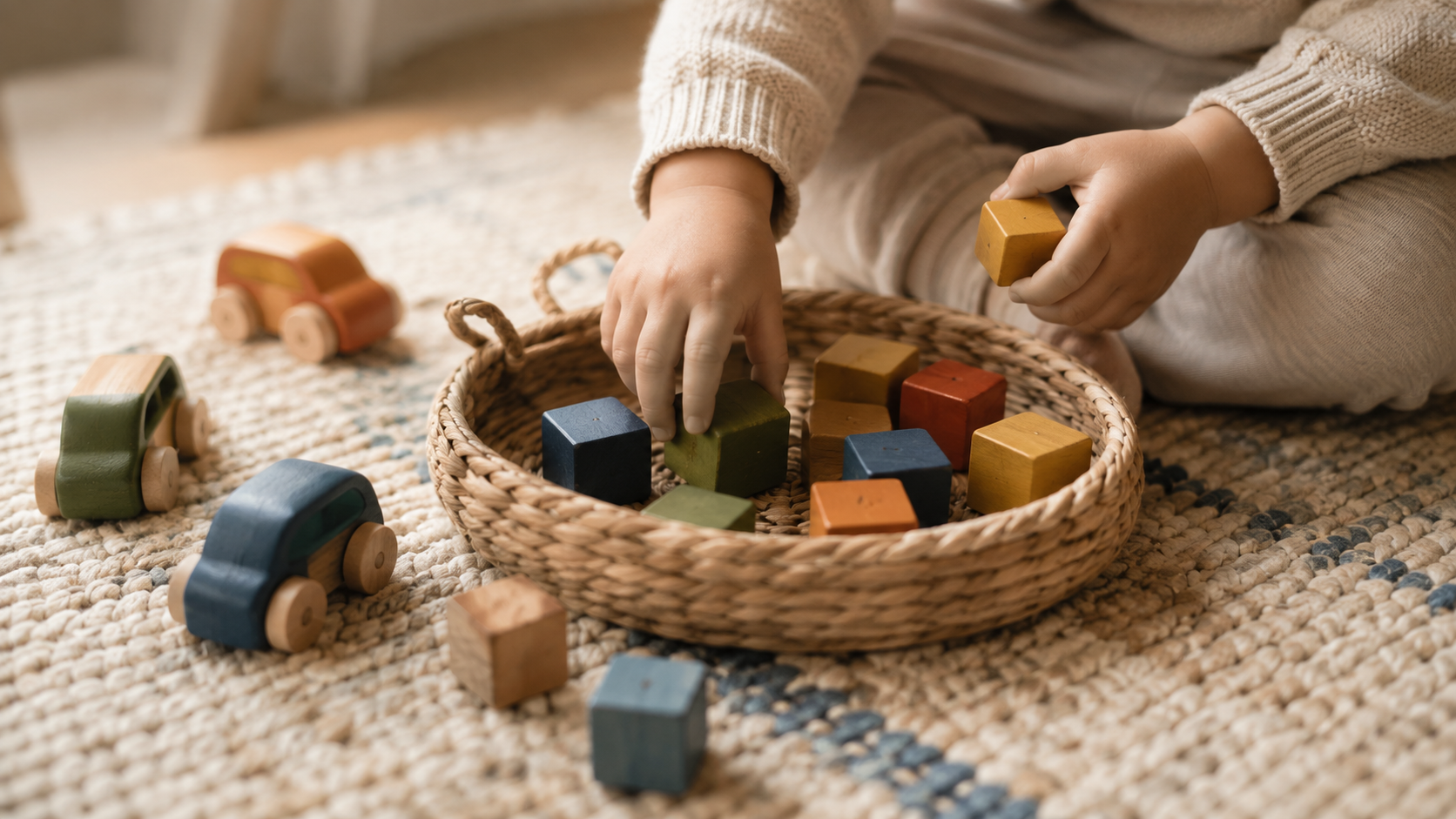
A weekly rhythm, not a rigid schedule
One of the biggest fears first-time homeschoolers have is "What if I can't keep up a schedule?" The course sidesteps that entirely by teaching a rhythm instead of a strict timetable — one that flexes around naps, moods, and real life, while still giving your child (and you) a predictable shape to the day.
Inside, you'll find a full sample daily rhythm and a five-day weekly overview you can literally copy for your first week, covering everything from morning basket time to afternoon science exploration — all in about 90 minutes of guided learning, spread throughout the day.
What you'll actually need to buy (spoiler: not much)
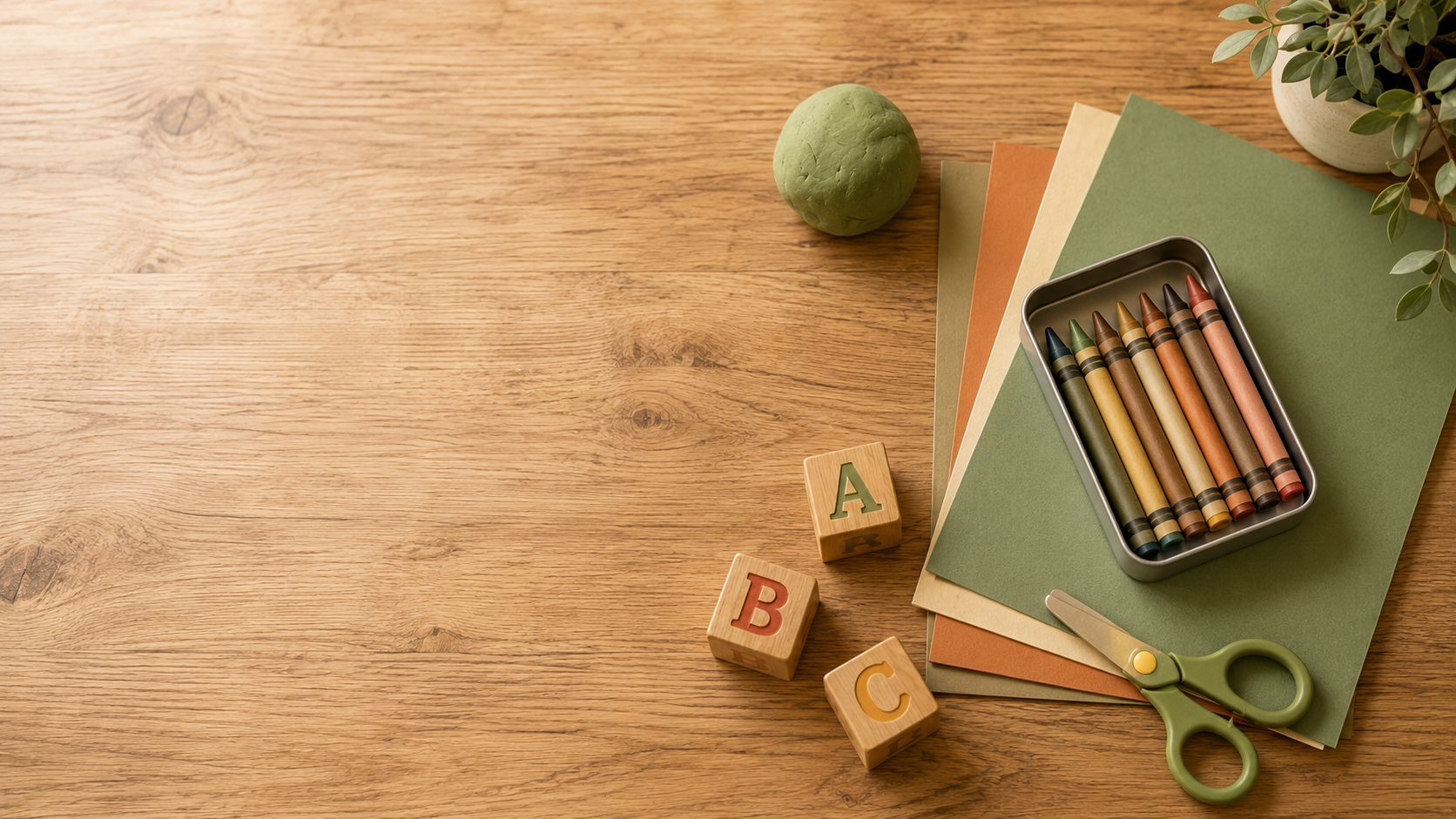
A lot of what stops moms from starting is the fear of the price tag. The course includes a full materials breakdown — split into true essentials, nice-to-haves, and free household substitutes — showing that most Pre-K learning can be done for under $75, using things like crayons, construction paper, playdough, and building blocks. Many families already have 60% of it sitting in a kitchen drawer.
Ready-to-use lesson plans, so day one isn't a guessing game
Rather than leaving you to figure out how to apply all of this, the course includes two full sample lesson plans — a Letter "B" day and a Counting to 5 day — that you can copy directly into your planner and try tomorrow, before customizing anything.
Tracking progress without tests, grades, or pressure
Pre-K doesn't need report cards. The course includes a simple monthly observation checklist covering language, letters, numbers, fine motor, gross motor, and social-emotional skills — so you can watch your child grow without ever comparing them to a curriculum's chart.
And when the hard days come
Because they will. The course closes with real, practical advice for staying sane over the long haul: protecting your own energy, building in a free-choice day each week, and knowing when to close the workbook and just go play. Burnout — not a bad lesson plan — is the real risk to a home preschool, and this course treats it that way.
Start where you are
You don't need to wait until you feel "ready." Little Learners at Home is designed to meet you exactly where you are — even if that's standing in your living room wondering if you can really do this.
Spoiler: you can.
👉 Get Little Learners at Home — an instant digital download you can start using today.
No teaching degree. No perfect playroom. Just you, your child, and a plan that actually fits real life.