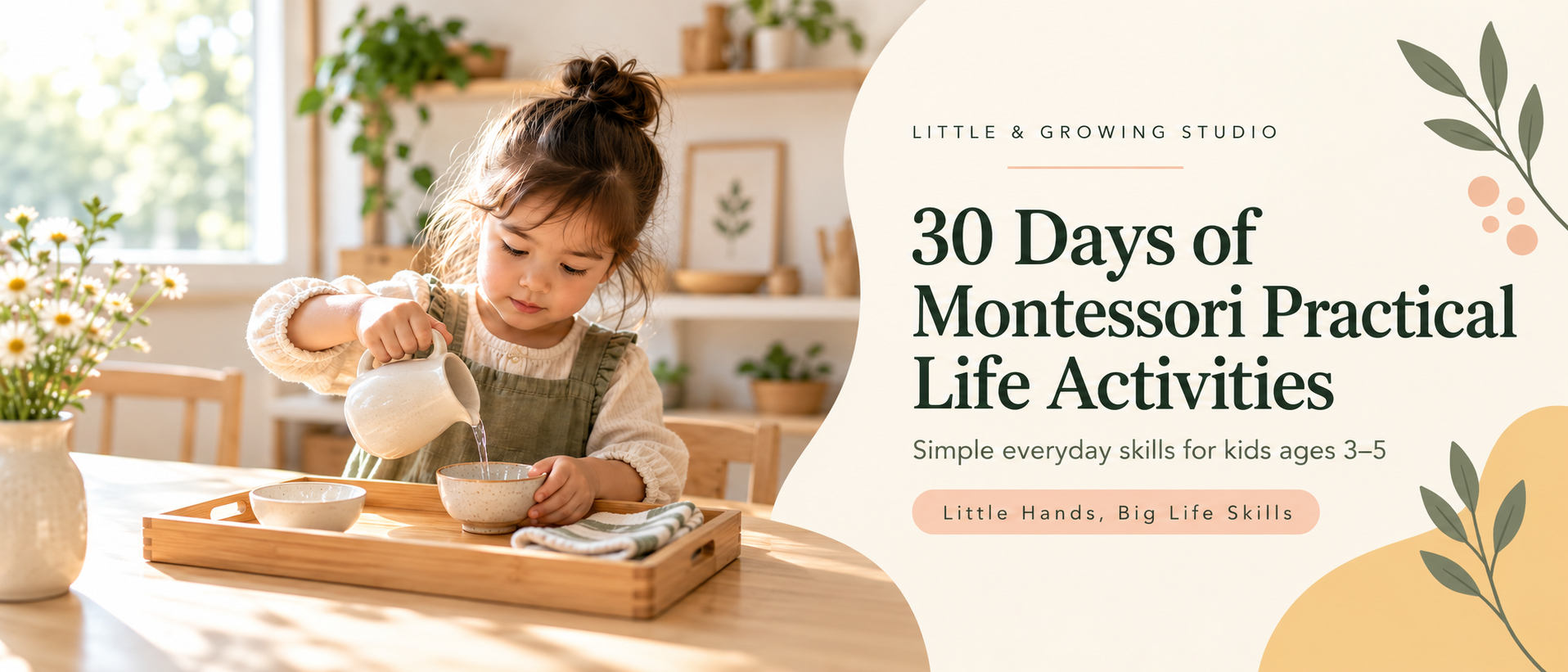
What if some of your child's most meaningful learning moments were already happening right at home?
Pouring water into a cup, folding a towel, setting the table, or watering a plant might seem like ordinary everyday tasks. But for young children, these moments are opportunities to build independence, strengthen coordination, practice concentration, and develop a sense of responsibility.
That's the beauty of Montessori-inspired practical life activities. Children learn by doing real, purposeful work — and the home is a wonderful place to begin.
The best part? You don't need expensive materials or an elaborate learning space.
With everyday household items, a little preparation, and plenty of patience, you can turn ordinary routines into meaningful learning experiences.
What Are Montessori Practical Life Activities?
Practical life activities are real tasks that help children learn how to care for themselves, their environment, and the people around them.
Unlike pretend chores or activities designed only to keep little hands busy, practical life tasks have a meaningful purpose.
When your child wipes a table after snack time, folds their clothes, or helps prepare a simple meal, they are practicing more than the task itself.
They're also developing:
Independence: Learning to complete familiar tasks with gradually less assistance.
Fine motor coordination: Strengthening small hand movements used in daily activities.
Concentration: Following a task from beginning to end.
Responsibility: Understanding how their actions contribute to family life.
Confidence: Experiencing the satisfaction of doing something themselves.
And perhaps most importantly, they're learning that they are capable of making a meaningful contribution.
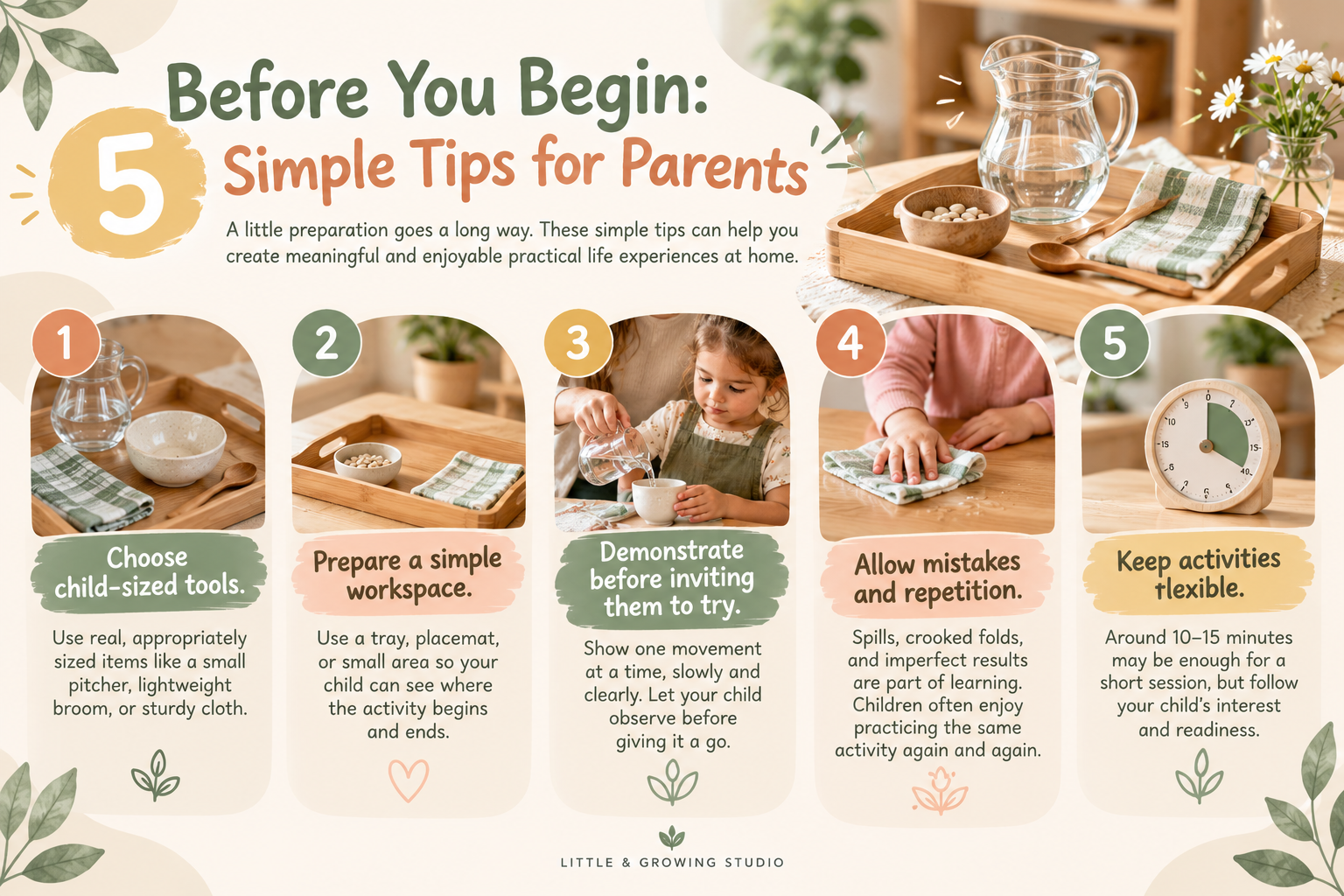
Before You Begin: Five Simple Tips for Parents
1. Choose child-sized tools. A small pitcher, lightweight broom, sturdy step stool, or appropriately sized cloth makes everyday tasks more manageable.
2. Prepare a simple workspace. Use a tray, placemat, or small designated area so your child can see where the activity begins and ends.
3. Demonstrate before inviting participation. Show one movement at a time, slowly and clearly. Give your child an opportunity to observe before trying.
4. Allow mistakes and repetition. Spills, crooked folds, and imperfect results are part of learning. Children often enjoy practicing the same activity again and again.
5. Keep activities flexible. Around 10–15 minutes may be enough for a short introduction, but follow your child's interest and readiness.
A gentle safety reminder: Always choose materials appropriate for your child's abilities. Small objects can be choking hazards, and activities involving scissors, graters, peelers, water, or other potentially hazardous tools require suitable adult supervision or direct assistance.
Your 30-Day Practical Life Activity Guide
We've organized these activities into six flexible weeks, with five activities in each week.
You can follow them in order, choose the tasks that fit your family's routine, or repeat your child's favorites.
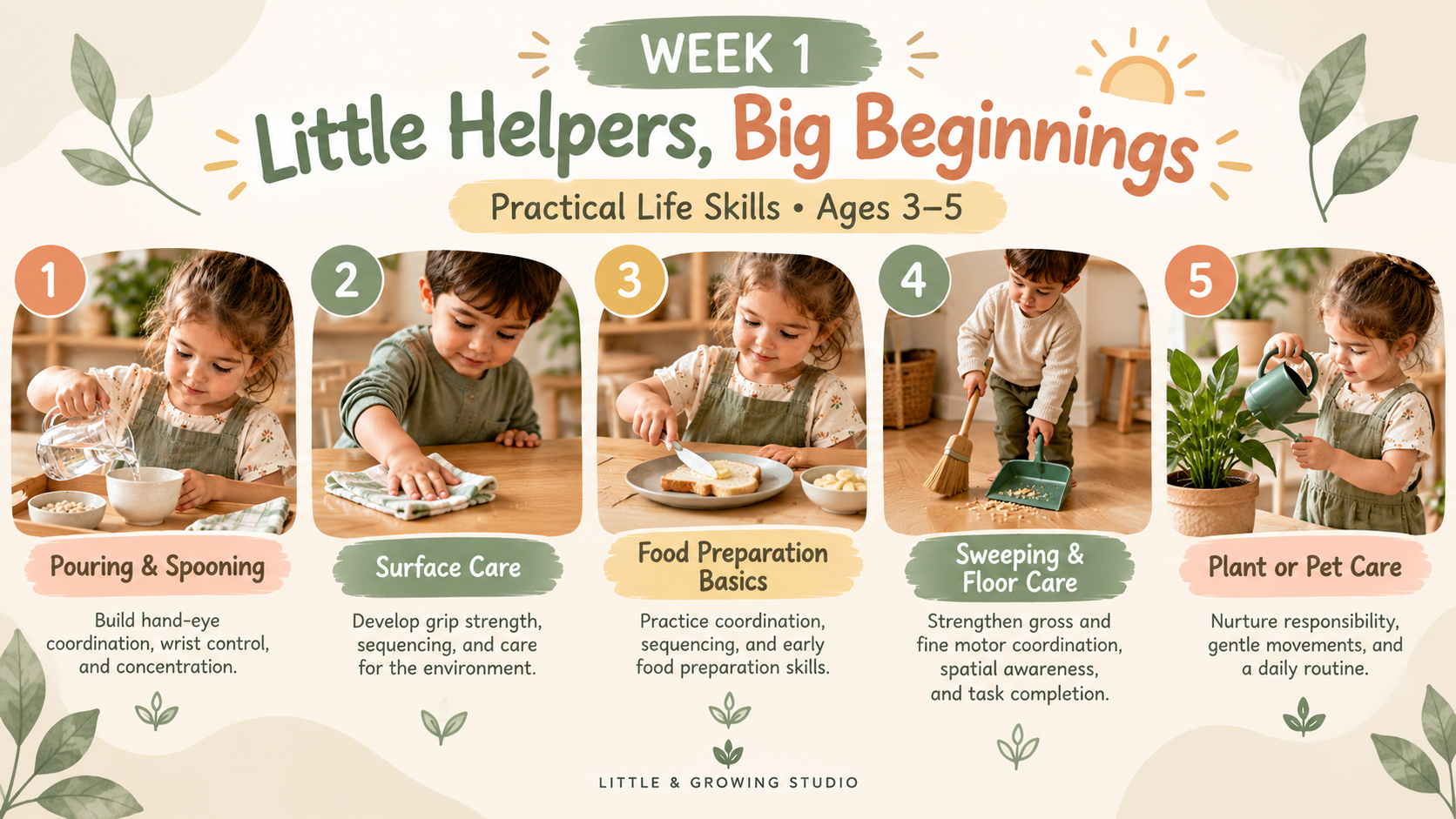
Week 1: Little Helpers, Big Beginnings
Focus: Hand coordination, care for the environment, and participation in everyday routines.
Day 1 — Pouring and Spooning
Gather two small bowls, a spoon, a small pitcher, and some dry materials suitable for your child's age.
Demonstrate how to pour from the pitcher into a bowl, transfer the contents using a spoon, and return everything to the starting position.
Skills practiced: Hand-eye coordination, wrist control, and concentration.
Parent tip: Begin with a small amount to reduce frustration and make cleanup manageable.
Day 2 — Surface Care
Offer a small water-filled spray bottle, a folded cloth, and a table or placemat-sized area.
Show your child how to spray a little water, wipe the surface, and fold the cloth afterward.
Skills practiced: Grip strength, sequencing, and environmental care.
Parent tip: A placemat can help your child recognize the area they are responsible for cleaning.
Day 3 — Food Preparation Basics
Invite your child to peel a banana, tear lettuce leaves, or spread a soft topping onto bread using an appropriate utensil.
Allow them to place the finished food on a plate and help bring it to the table.
Skills practiced: Coordination, sequencing, and early food preparation.
Parent tip: Whenever possible, let your child prepare part of a real snack.
Day 4 — Sweeping and Floor Care
Provide a child-sized broom, dustpan, and a small area marked with painter's tape.
Demonstrate how to sweep safe scraps into the marked area, collect them, and dispose of them.
Skills practiced: Spatial awareness, coordination, and task completion.
Parent tip: Sweeping crumbs after snack time gives the activity a genuine purpose.
Day 5 — Plant or Pet Care
Invite your child to help water a suitable plant or participate in an adult-guided pet care routine.
Show how to use the correct amount of water or food, then return the tools to their place.
Skills practiced: Gentle movements, responsibility, and care for living things.
Parent tip: Try connecting this activity to an existing daily routine.
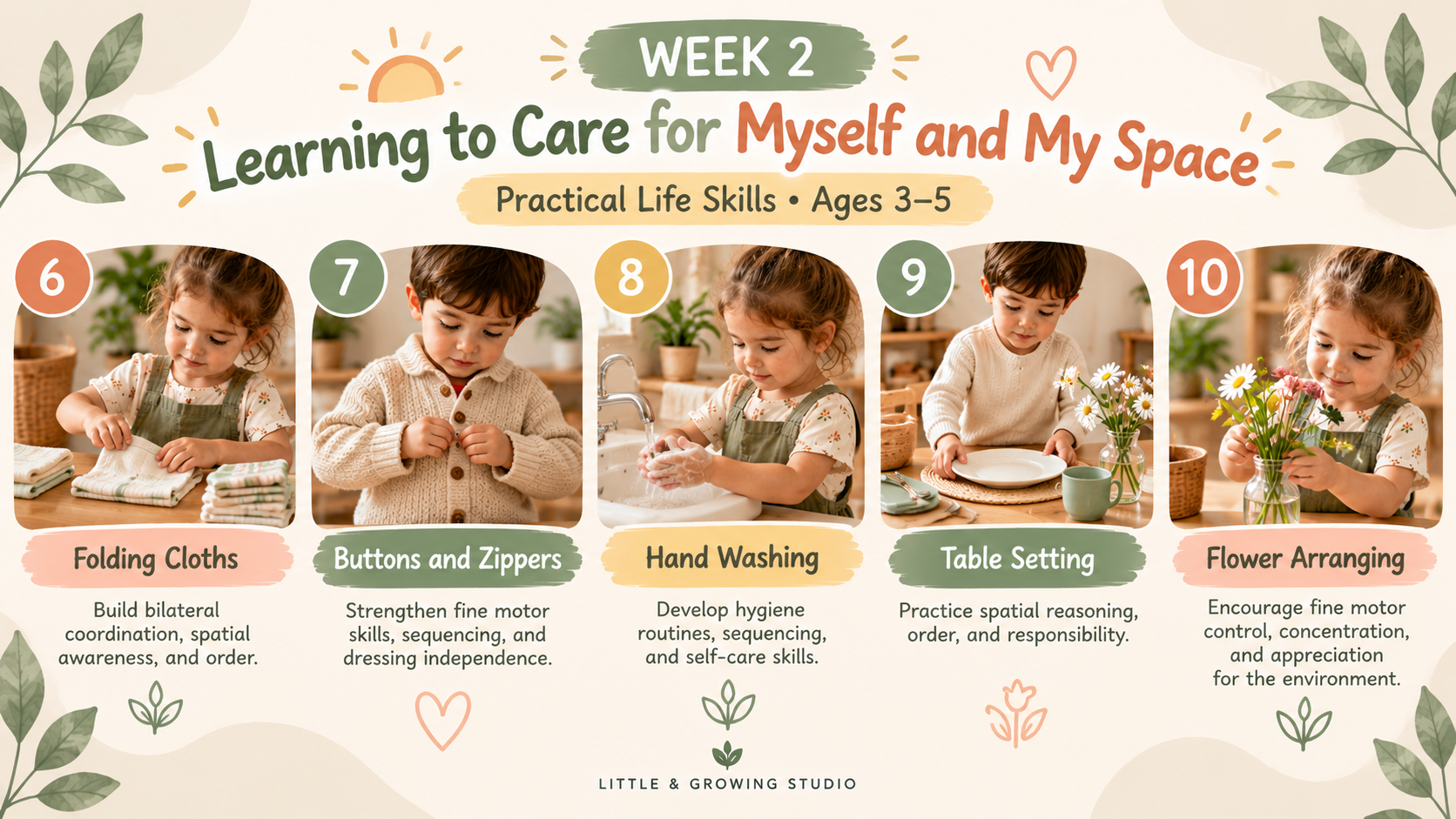
Week 2: Learning to Care for Myself and My Space
Focus: Self-care, order, and independence.
Day 6 — Folding Cloths
Provide several square cloths or napkins. Demonstrate laying one flat, folding it in half, and placing it in a basket.
Skills practiced: Bilateral coordination, spatial awareness, and order.
Parent tip: Begin with fabrics that hold their shape easily.
Day 7 — Buttons and Zippers
Use an old shirt with large buttons or a jacket with a zipper.
Allow your child to practice opening and closing the fasteners without the pressure of getting dressed quickly.
Skills practiced: Fine motor precision, sequencing, and dressing independence.
Parent tip: Let your child repeat one fastening movement before moving to the next.
Day 8 — Hand Washing
Make soap, a towel, and a safe step stool accessible.
Demonstrate wetting hands, washing with soap, rinsing, and drying. Help your child learn to wash thoroughly, including between their fingers.
Skills practiced: Hygiene, sequencing, and self-care.
Parent tip: Practice the routine together until the sequence becomes familiar.
Day 9 — Table Setting
Create a simple placemat with outlines for a plate, cup, and utensils.
Invite your child to carry each safe item to the table and place it in its matching position.
Skills practiced: Spatial reasoning, order, and responsibility.
Parent tip: Use the placemat as a visual guide rather than correcting every mistake.
Day 10 — Flower Arranging
Gather a few child-safe flowers or artificial stems and a small, stable vase.
Let your child arrange the flowers one at a time, adjusting their positions until satisfied.
Skills practiced: Fine motor control, concentration, and appreciation for the environment.
Parent tip: Invite your child to choose where the finished arrangement will be displayed.
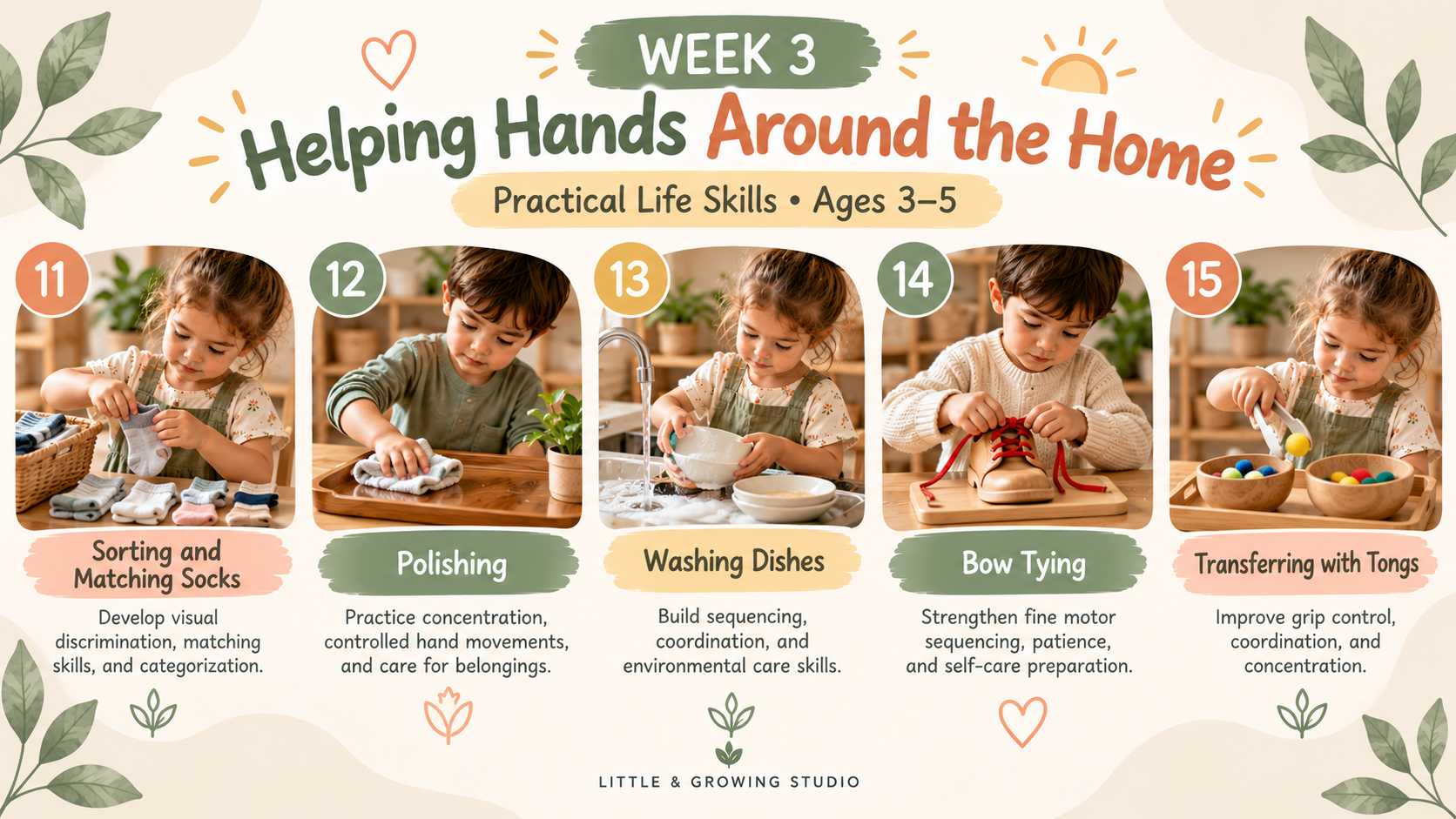
Week 3: Helping Hands Around the Home
Focus: Matching, coordinated movements, and meaningful household contributions.
Day 11 — Sorting and Matching Socks
Place three or four clearly different pairs of clean socks in a basket.
Invite your child to find matching pairs and fold them together.
Skills practiced: Visual discrimination, matching, and categorization.
Day 12 — Polishing
Choose a safe household object and provide a damp cloth and a dry buffing cloth.
Demonstrate wiping in small circles, then drying the surface.
Skills practiced: Concentration, controlled hand movements, and care for belongings.
Day 13 — Washing Dishes
Prepare a small basin of soapy water, rinse water, a sponge, and unbreakable dishes.
Show your child how to wash, rinse, and place each item on a drying towel or rack.
Skills practiced: Sequencing, coordination, and environmental care.
Day 14 — Bow Tying
Use a lacing practice board or a shoe secured on a flat surface.
Demonstrate crossing the laces, making a knot, and gradually introducing the steps of tying a bow.
Skills practiced: Fine motor sequencing, patience, and self-care preparation.
Day 15 — Transferring with Tongs
Prepare two bowls, child-sized tongs, and large objects appropriate for your child's age, such as cotton balls or large pom-poms.
Invite your child to transfer each object from one bowl to another.
Skills practiced: Grip control, coordination, and concentration.
Parent tip for the week: These activities don't need to be completed quickly. Encourage your child to work carefully and repeat the steps as often as they enjoy.
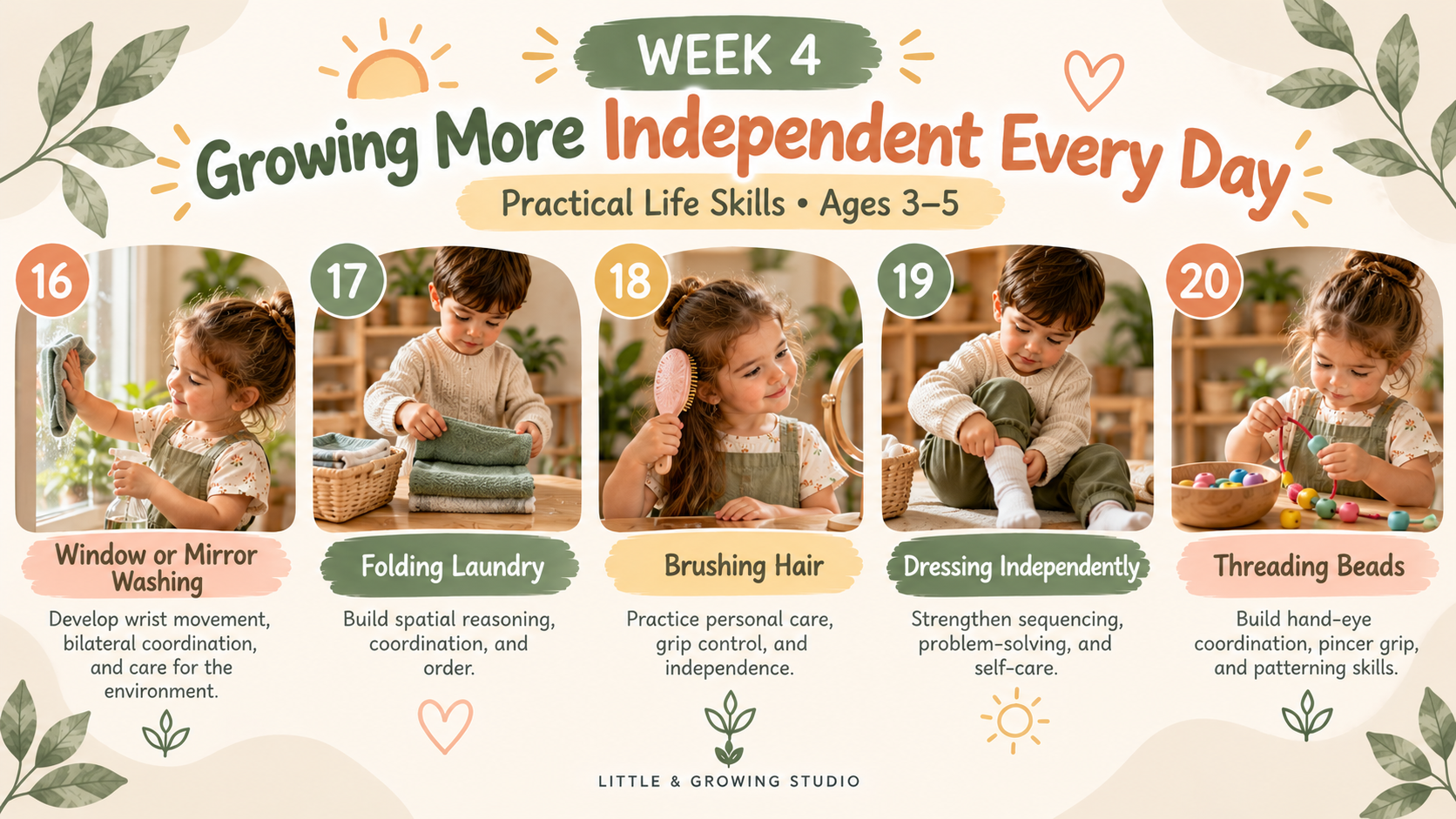
Week 4: Growing More Independent Every Day
Focus: Personal care, spatial awareness, and confidence in daily routines.
Day 16 — Window or Mirror Washing
Offer a small water spray bottle and soft cloth for a low, accessible, unbreakable mirror or another suitable surface.
Show your child how to wipe and dry a small area.
Skills practiced: Wrist movement, bilateral coordination, and environmental care.
Day 17 — Folding Laundry
Provide a small basket of clean towels or clothing.
Begin with simple square items before introducing clothing with sleeves.
Skills practiced: Spatial reasoning, coordination, and order.
Day 18 — Brushing Hair
Place a child-sized hairbrush and mirror within reach.
Demonstrate gentle brushing. A doll can be useful for initial practice.
Skills practiced: Personal care, grip control, and independence.
Day 19 — Dressing Independently
Offer easy-to-manage clothing, such as elastic-waist trousers and shoes with simple fasteners.
Give your child time to check the orientation of each garment and try putting it on.
Skills practiced: Sequencing, problem-solving, and self-care.
Day 20 — Threading Beads
Provide large beads and a suitable lacing cord under close adult supervision.
Invite your child to thread beads one at a time or make a simple color pattern.
Skills practiced: Hand-eye coordination, pincer grip, and patterning.
Parent tip for the week: Rather than doing the task immediately when your child struggles, offer just enough help for them to continue.
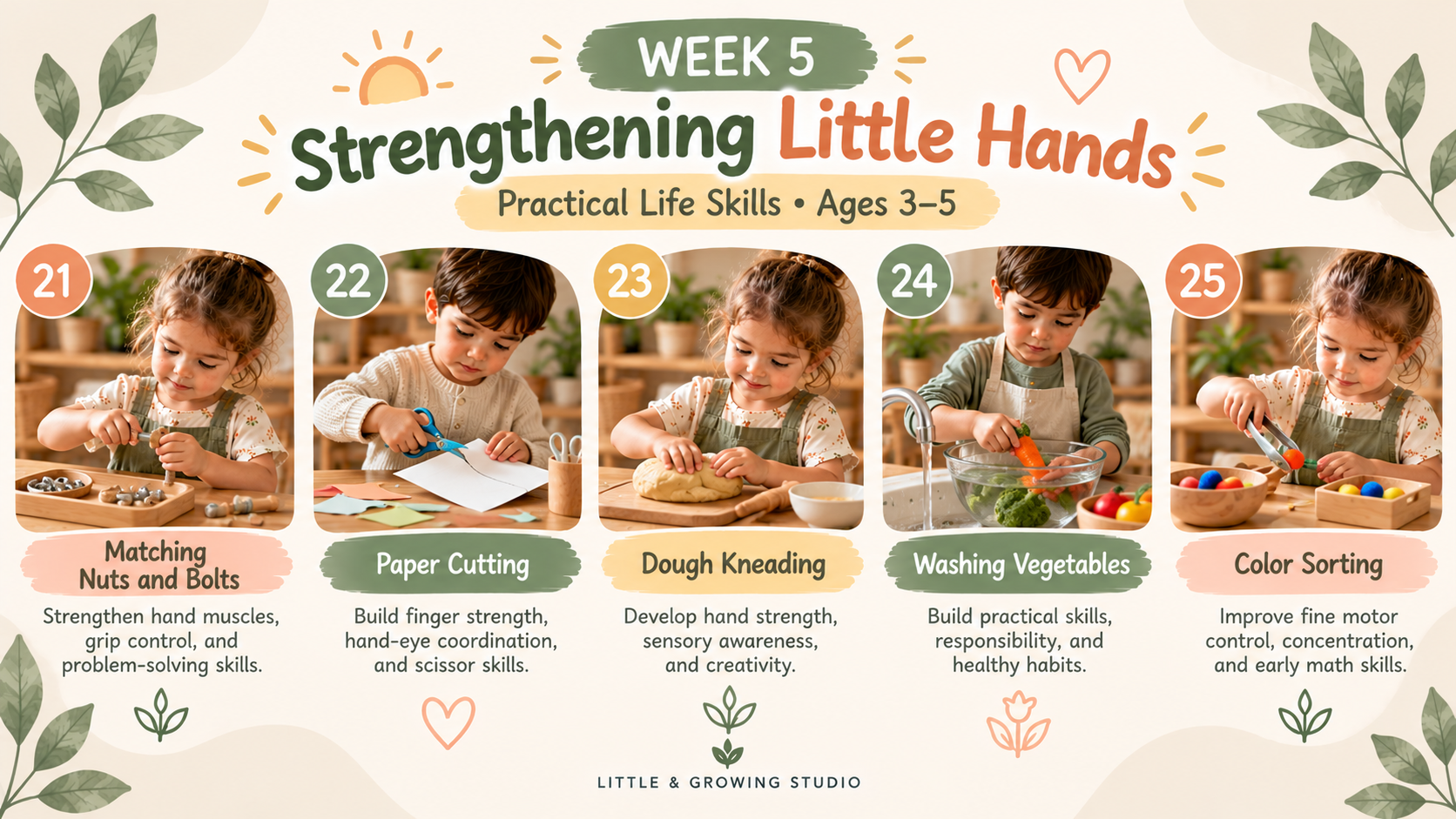
Week 5: Strengthening Little Hands Through Everyday Work
Focus: Fine motor precision, hand strength, and early problem-solving.
Day 21 — Matching Nuts and Bolts
Use large, child-safe matching pieces designed for children's use.
Demonstrate how to pair and gently twist the matching pieces together.
Skills practiced: Wrist rotation, matching, and fine motor coordination.
Day 22 — Cutting with Scissors
Provide age-appropriate scissors and narrow strips of paper.
Begin with individual snips before introducing longer cutting lines.
Skills practiced: Hand strength, bilateral coordination, and precision.
Day 23 — Clay or Dough Kneading
Give your child a small ball of playdough or suitable dough.
Invite them to squeeze, roll, press, flatten, and repeat.
Skills practiced: Hand strength, sensory exploration, and concentration.
Day 24 — Washing Fruits and Vegetables
Prepare a colander, a vegetable brush, clean water, and sturdy produce.
Show how to rinse and gently scrub each item before setting it aside to dry.
Skills practiced: Coordination, sequencing, and food preparation awareness.
Day 25 — Color and Size Sorting
Gather safe household objects in two contrasting colors or sizes.
Invite your child to place the objects into matching containers.
Skills practiced: Categorization, visual discrimination, and vocabulary.
Parent tip for the week: Activities that strengthen little hands can support the coordination children later use for drawing, writing, and other classroom tasks.
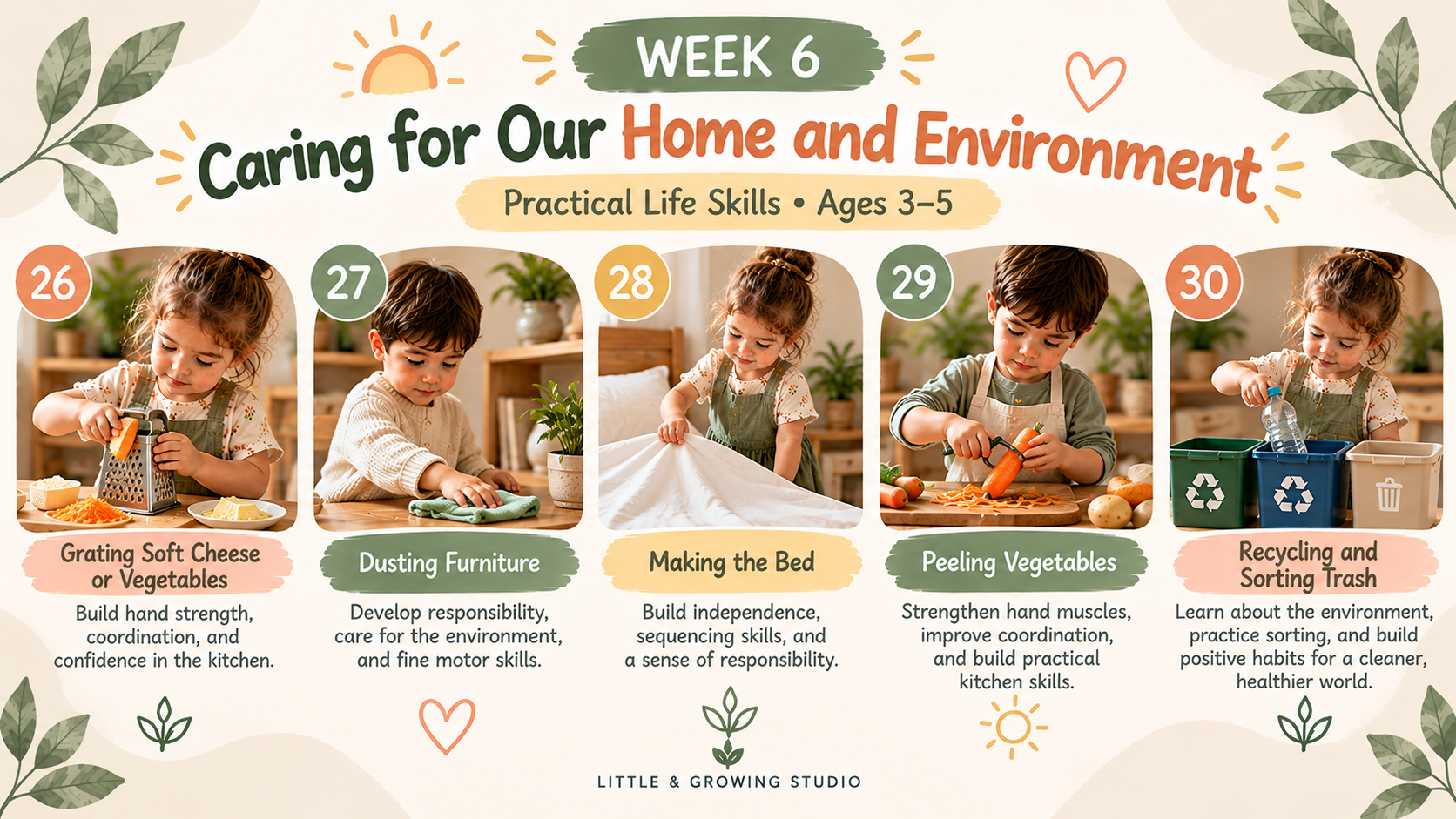
Week 6: Caring for Our Home and Environment
Focus: Responsibility, independence, and contributing to family routines.
Day 26 — Grating Soft Food
With direct adult assistance, introduce an appropriate child-safe grater and a suitable soft food.
Demonstrate the movement while carefully keeping fingers away from the grating surface.
Skills practiced: Coordination, wrist control, and food preparation sequencing.
Day 27 — Dusting Furniture
Provide a soft cloth or small duster.
Invite your child to dust a low, accessible shelf and return the tool afterward.
Skills practiced: Coordination, attention to detail, and environmental care.
Day 28 — Making the Bed
Invite your child to pull up their blanket, smooth the bedding, and position their pillow.
Skills practiced: Gross motor coordination, sequencing, and responsibility.
Parent tip: A slightly wrinkled bed that your child made themselves is a meaningful accomplishment.
Day 29 — Peeling Vegetables
With close, hands-on adult support, introduce an age-appropriate peeler and a suitable vegetable.
Demonstrate safe positioning and peeling away from the body.
Skills practiced: Bilateral coordination, wrist control, and food preparation awareness.
Day 30 — Recycling and Sorting
Prepare picture-labeled recycling, compost, and trash containers with clean, safe sample items.
Invite your child to decide where each item belongs.
Skills practiced: Categorization, environmental awareness, and responsibility.
Parent tip: Keep the labels visible so your child can eventually help with suitable everyday sorting tasks.
How to Adapt These Activities for Different Abilities
Children ages 3–5 vary greatly in their experience, coordination, attention, and confidence.
A younger or less experienced preschooler may benefit from larger materials, fewer steps, and more demonstration. A child who is ready for an additional challenge may enjoy longer sequences, sorting more categories, or taking responsibility for a familiar routine.
Try following these principles:
Start with simpler materials and introduce difficulty gradually.
Offer assistance when necessary without taking over the task.
Use visual guides for activities with several steps.
Allow favorite activities to be repeated.
Keep potentially hazardous steps adult-led or save them for when your child is ready.
Remember that these are flexible learning opportunities, not milestones every child must accomplish at a particular age.
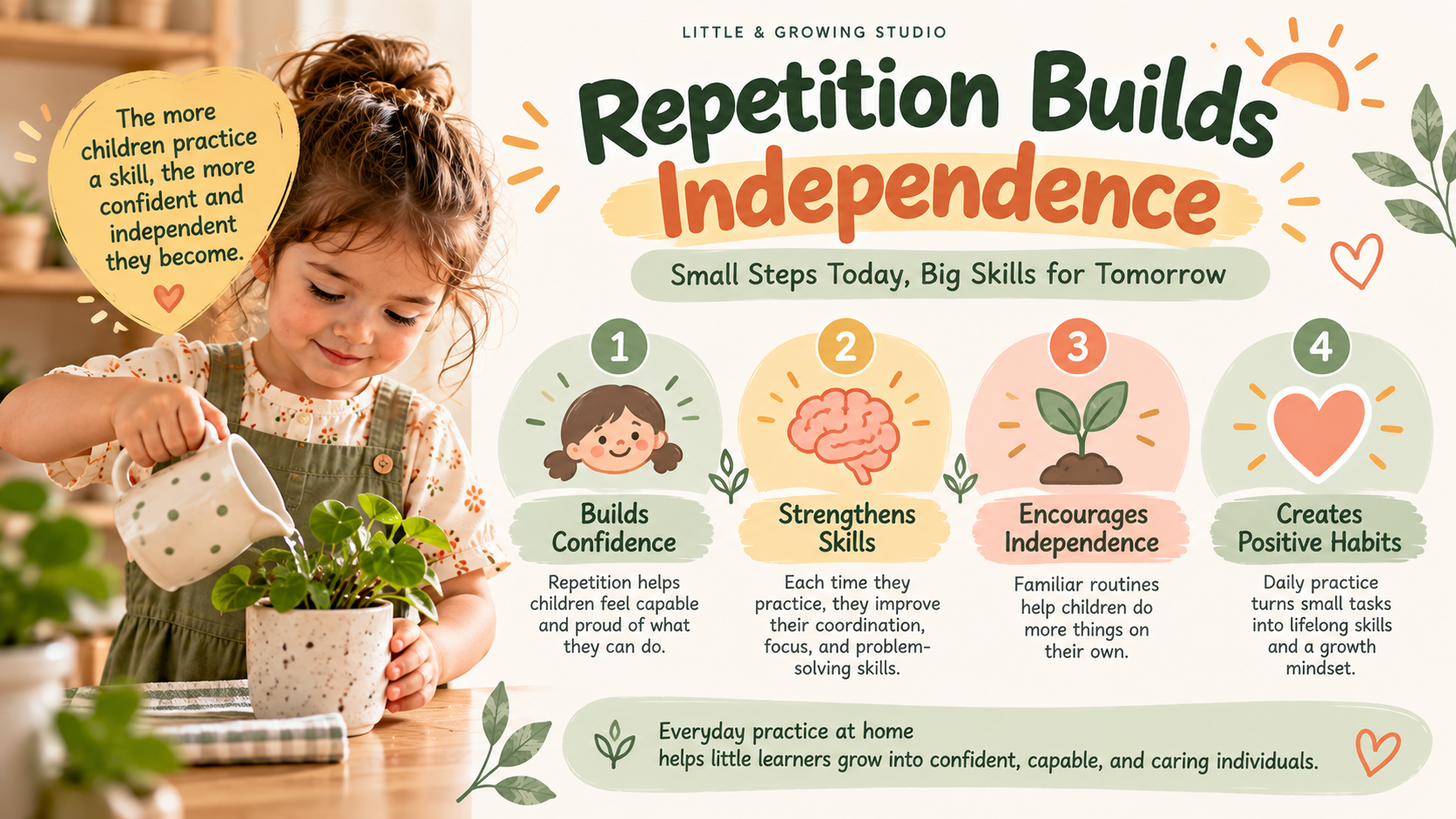
Why Repetition Matters More Than Completing 30 Days
Perhaps your child wants to pour water every morning.
Maybe they enjoy folding the same towel repeatedly, or they spend longer transferring objects than you expected.
That's okay!
Practical life learning isn't about moving on to a new activity every day.
Repeated practice offers children opportunities to refine their movements, become more familiar with the sequence, and gain confidence.
When an activity becomes a favorite, invite your child to enjoy it again.
Progress doesn't always look like something new. Sometimes it looks like doing something familiar with a little more independence.
🌿 Bring Practical Life Learning Into Your Home — Get Your FREE Starter Guide!
Now that you've explored 30 Montessori practical life activities, you might be wondering, “Where should we begin?”
Remember, you don't need to introduce all 30 activities at once. Sometimes, the most meaningful learning starts with just one simple task, a little patience, and the opportunity for your child to try something independently.
To help you get started, we've created a FREE Montessori Practical Life Starter Guide, designed especially for parents of children ages 3–5.
Inside, you'll discover five beginner-friendly activities, including pouring and spooning, surface care, folding cloths, table setting, and plant care. Each activity comes with simple step-by-step instructions, materials you likely already have at home, developmental benefits, and helpful parent tips.
We've also included a 4-Week Little Skills Tracker so you can celebrate your child's growing confidence, recognize new accomplishments, and make practical life learning part of your everyday routine.
Because remember, it's not about completing every activity perfectly. It's about giving your child meaningful opportunities to learn, explore, and proudly say, “I can do it myself!” 💚
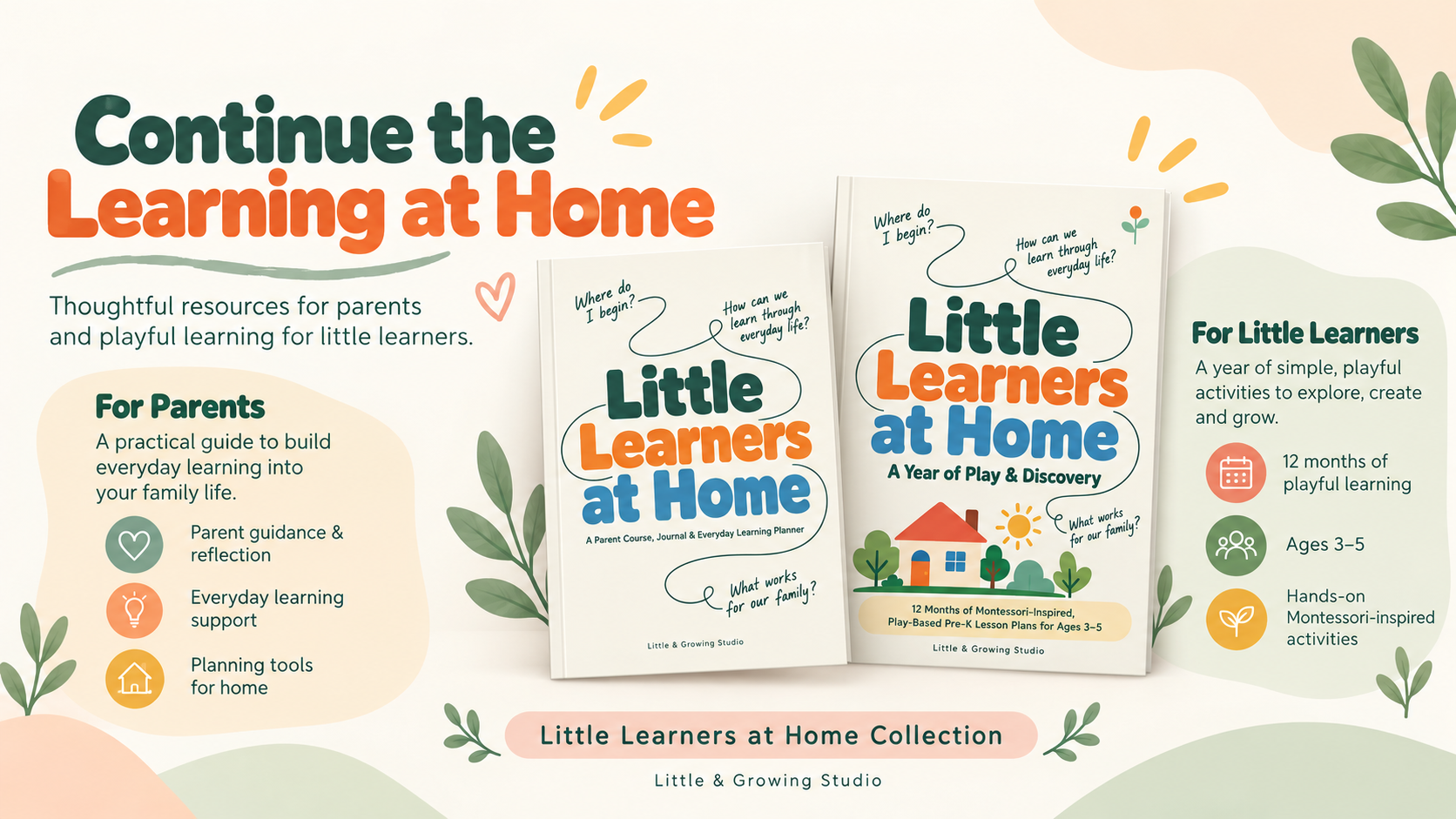
Continue the Learning with Little Learners at Home
These 30 activities are a wonderful beginning, but meaningful home learning can extend far beyond a single month.
At Little & Growing Studio, we believe everyday routines, purposeful play, and supportive parent-child interactions can create rich learning opportunities.
That's why we've developed two complementary Little Learners resources.
Little Learners at Home: A Parent Course, Journal & Everyday Learning Planner
Designed to support parents who want to create more intentional learning experiences at home.
Explore approaches to supporting your child, organizing routines, and reflecting on your family's everyday learning journey.
Little Learners at Home: A Year of Play & Discovery
Looking for more structured activity planning?
Discover a 12-month Montessori-inspired curriculum for children ages 3–5, with 48 weeks of playful learning opportunities across early literacy, cognitive and math development, sensory and fine motor skills, movement, and practical life independence.
Together, these resources can help you move from occasional learning activities toward a more thoughtful and consistent home learning experience.
Explore here the Little Learners at Home collection from Little & Growing Studio.
A Final Thought: Let Them Help
The next time your child asks to wipe the table, fold the laundry, prepare a snack, or water a plant, consider inviting them to participate.
It may take a little longer. There might be spills, misplaced utensils, or crooked folds.
But behind those imperfect moments, your child is learning something meaningful.
They're discovering that their hands can do real work, their contributions matter, and they are becoming more capable every day.
Because every day learning begins with little hands, meaningful moments, and the freedom to try.
